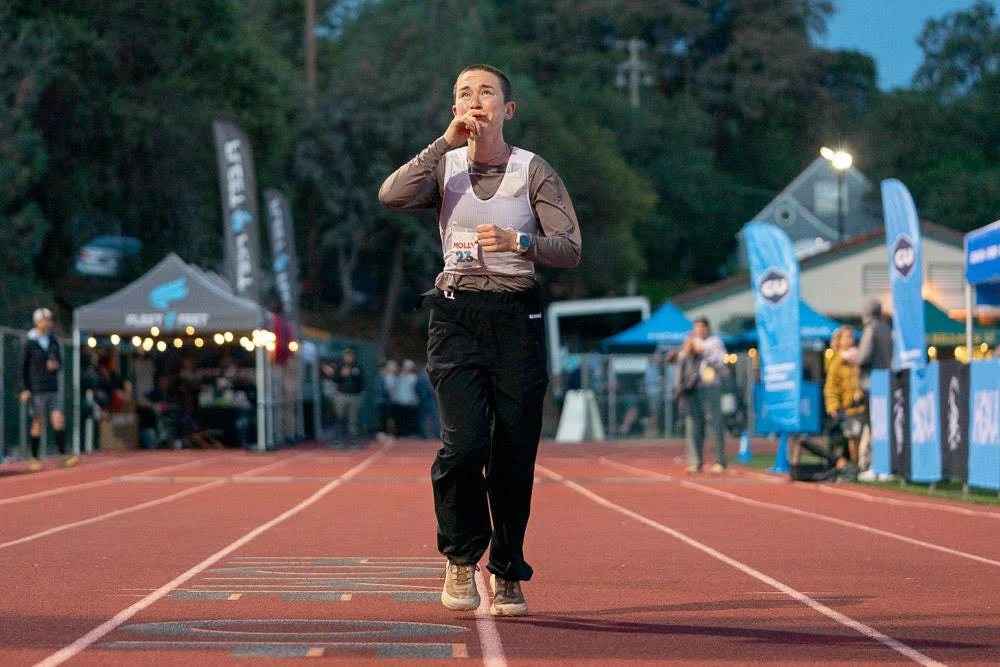
Early Sunday morning, Molly Seidel ran around the Placer High School track in Auburn, California, and reached the finish line of the Western States 100 with little fanfare but a big smile on her face.
After 24 hours, 29 minutes, and 27 seconds of running, jogging, and walking, Seidel was greeted with celebratory hugs from her pacers and crew after finishing her first attempt at running 100 miles.
It might not have been the outcome that she or anyone had envisioned—especially given that she finished a full nine hours behind Jenn Lichter’s record-setting win (15:28:05)—but Seidel said just finishing was a memorable experience that has her hungry for more.
“I feel like it’s been such a steep learning curve with all of this,” said Seidel, 31, who lives in Flagstaff, Arizona, where many top runners trained for the race. “I was thinking of that as I was running along. I was like, man, it has been a really, really fast ramp up and I still have a lot to learn. And so this was definitely a hard lesson to learn, but I’m grateful that I was able to stick through and still finish the race, which, especially with a race like this, I feel like that's kind of what it’s about.”
Seidel, the bronze medalist in the marathon at the Tokyo Olympics in 2021, shifted her focus to trail running last summer and had outstanding results in her first ultradistance races earlier this year.
She was the outright winner of a low-key 50K race (4:09) in Texas in January, then earned a golden ticket to Western States after placing fourth in the Black Canyon Ultras 100K (8:25) on February 14 in Arizona. She also placed third in the highly competitive Canyons Endurance Runs 50K (4:07) on April 24 in Auburn.
But making the leap to running 100 miles in the most competitive ultramarathon in the U.S. proved to be a tall order with some very challenging experiences.
Amid windy and colder-than-expected conditions, the race began at 5 a.m. PST on Saturday at the base of Palisades Tahoe ski resort in Olympic Valley, California, and sent runners over the 8,750-foot summit of Emigrant Pass before descending along the undulating trails in the American River canyons all the way to Auburn.
Although she was the fourth woman to complete the initial 4-mile, 2,000-foot climb to the summit, she intended to run conservatively and settled into a groove on the challenging trails on the back side of the pass. She was in 10th place at the 24.4-mile Duncan Canyon aid station, which she reached in 3:53 about 3 minutes behind the lead group of women.
She was still running well and had moved up to eighth place by the 47.8-mile mark, but she was starting to experience foot problems and severe skin chafing and inadvertently got behind on refueling with gels and liquid carbohydrate drinks.
Seidel was still in 10th place among women when she hobbled into the 55.7-mile aid station amid temperatures in the upper 70s in the remote residential community of Michigan Bluff just after 2 p.m., but her feet hurt so bad that her support crew had trouble getting her shoes off. After changing her shorts and shoes, she refilled her water bottles and checked in with her coach Cliff Pittman, but by the time she left the aid station 14 minutes later, she had lost 10 places and was moving much more slowly and was soon reduced to power hiking and walking.
The lack of consistent fueling really caught up with her on the next segment, and it took her almost 3 hours to cover the next 7 miles on the way up to the 62-mile aid station in the town of Foresthill. But by then she was in 22nd place and her race strategy had to refocus on just finishing the race without getting hurt.
“She got behind on fueling, and that was a rookie mistake, and the chaffing was something she never had to deal with before,” Pittman said. “Plus, we were at the 10-hour mark of running and we were in uncharted territory. She had never run that long before. So from that point on, she wasn’t going to be running fast. It was more about, ‘let’s just get to the finish.’”
She was joined by pacer Alyssa Clark on the way out of Foresthill, and they averaged 12-minute miles over the next 18 miles. She reached the 78-mile Rucky Chucky aid station at 8:24 p.m., where she waded across the American River just moments before Lichter would cross the finish line in record-setting time in Auburn.
Seidel climbed the trail out of the river canyon just before sunset. Amid a mix of slow jogging, walking, and numerous stops through the night, Seidel continued on her quest to reach the finish line.
She reached the 90-mile mark just before midnight, but by the 94.3-mile Pointed Rocks aid station at 2:25 a.m., Seidel was having stability issues with one of her knees and began showing signs of hypothermia. Medical staff evaluated and wrapped the knee, then her support crew tucked her into a sleeping bag with hot water bottles so she could warm up and take a nap.
She wasn’t injured, but she was suffering from severe fatigue and soreness that inhibited her ability to run, Pittman said.
“She was having the full ultra experience, for sure,” Pittman said. “So we were there for a few hours in that aid station, and I kept saying, ‘this is your decision. I support you either way, no matter what you choose, I’m behind you.’ And after a few hours, she just said, ‘Let’s get it done,’ and she throws off the sleeping bags, puts on her shoes, and takes off running.”
Seidel covered the final 4-mile stretch of trail with new pacer Jessa Hanson in the pre-dawn hours of Sunday morning, then climbed the steep section of road to reach Robie Point, which signified she had about one mile to reach the finish line. As the first light of the day began to brighten the sky, Seidel walked and jogged her way with Clark, Hanson, and her entire support crew down to the track, then, summoning whatever energy she had left, picked up the pace slightly as she ran to the finish line.
Running the final meters alone, she took off her sweatshirt, twirled it over her head, and crossed the finish line more than a full day after she started. She smiled as she received her finisher’s medal before being embraced by her crew.
“It was really special having my crew all run the final mile with me,” Seidel said. “It really was amazing just being out on the trail and the amount of support that I was getting from everybody, whether it was other runners, the aid station volunteers, and spectators. I think that's what makes the sport really special, that people were just stoked to see me out there just still doing it. And I think that really filled my heart up.”
Seidel wound up in 28th place among women and 141st overall (out of what would be 323 finishers). Several hours later, after the final finishers squeaked under the 30-hour cutoff time, Seidel received her commemorative bronze finisher’s belt buckle and got a loud round of applause from the other finishers, spectators, and support crew members.
“Speechless at what (Molly Seidel) just did,” Hanson posted on Instagram. “Running 100 miles. pushing through so many levels of hell. managing to smile at what felt like an impossible task. fearlessly chasing goals and dreams. expressing gratitude through every high and every low. cultivating one of the most special and unique group of humans. what a weekend. what a life!! pics to come but for now need to come down from the emotional hangover of one of the most memorable weekends of my life.”
Seidel says she’ll take plenty of time to rest and recover before getting ready for the OCC 50K race in Chamonix, France, in late August. She said she’s still all-in on trail running and hopes to return to the Western States 100 next year.
“I had been fully planning on dropping out at Foresthill, but seeing the team and everybody really rallying for me was amazing,” Seidel said. “They were in it for the long haul and stuck with me through the entire night. It definitely wasn’t the racing experience that I’d hoped I’d have here, but it was definitely the ultramarathon experience and a really cool first 100-mile experience.”
Brian Metzler is a Boulder, Colorado, writer and editor whose work has appeared in Runner’s World, Sports Illustrated, ESPN, Outside, Trail Runner, The Chicago Tribune, and Red Bulletin. He’s a former walk-on college middle-distance runner who has transitioned to trail running and pack burro racing in Colorado.
