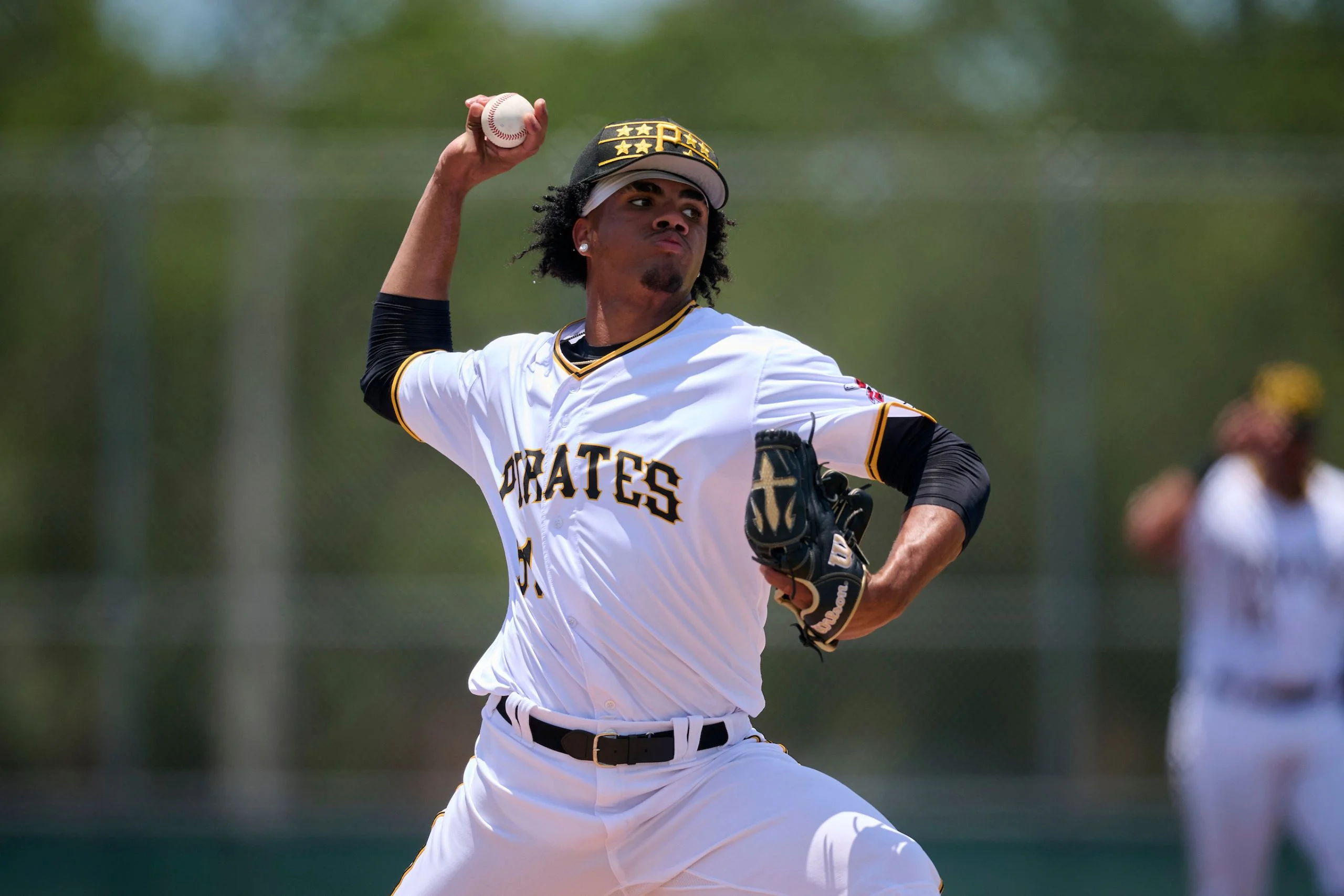
Every Monday morning, we highlight 10 players who stood out to us based on their underlying Statcast metrics. Data will usually be through Saturday of that week, but may include some data from Sunday games. These are not full scouting reports, but often serve as good early indicators of prospects who might be ready to break out or are demonstrating MLB-ready skills.
Last week, we dove into the subtle tweaks that Héctor Rodríguez made to unlock his substantial potential and looked at George Lombard Jr.‘s extremely well-rounded profile. This week we’ll discuss:
- The best pure-stuff fastball in the minors?
- What JoJo Parker needs to work on
- Leonardo Bernal being ready for the show
- Max Anderson squeezing the most out of his tools
- Lluveres Severino’s bowling-ball sinker
- College Pitcher Spotlight: Oregon’s Tanner Bradley
10 Statcast Standouts
Carlos Mateo, RHP, Pirates
A couple weeks ago, we marveled at Marty Gair’s potentially elite fastball. Today, we’re going to show you a fastball that’s perhaps even better than that one:
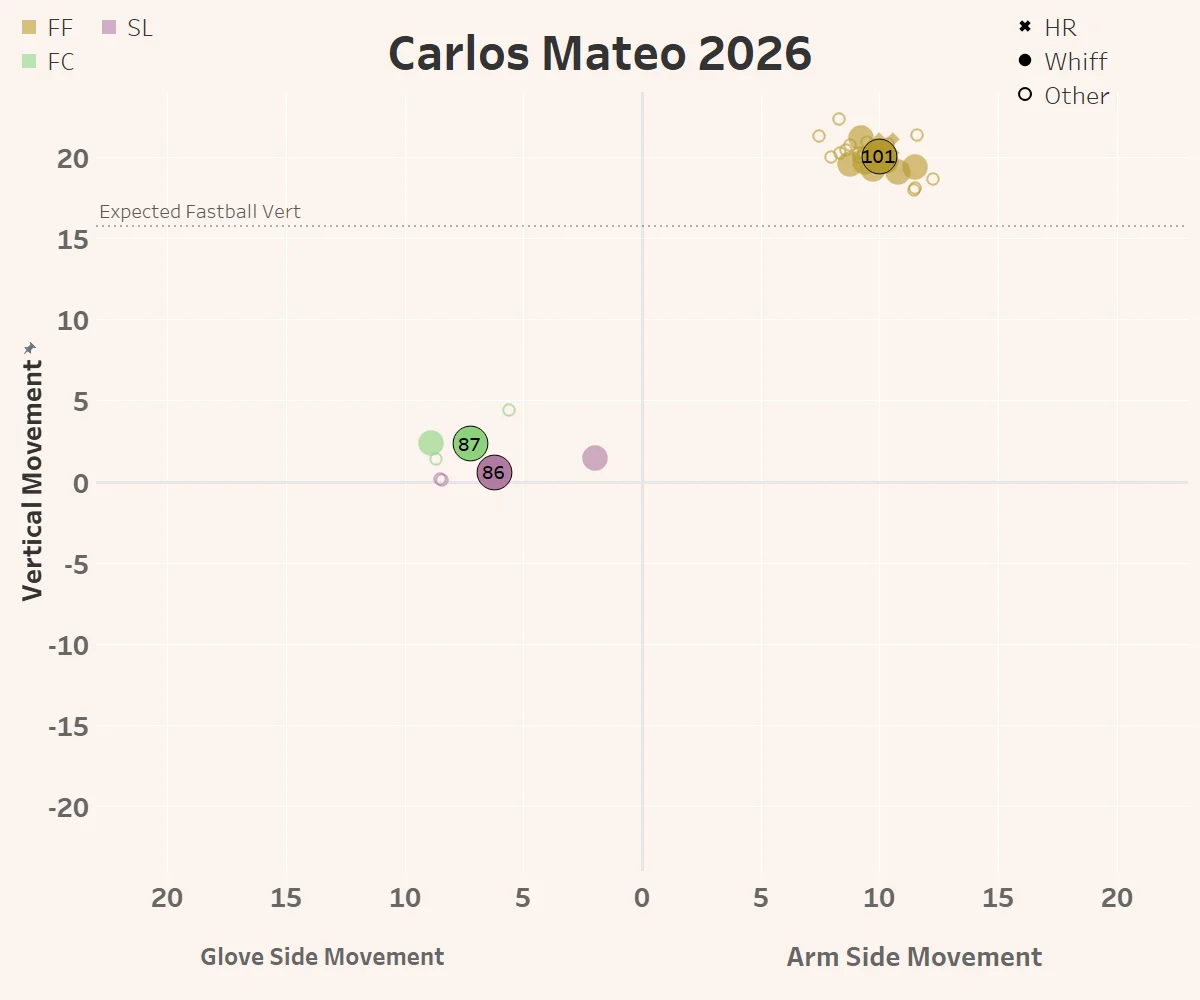
From a pure stuff perspective, that’s about as perfect as it gets. A really good stuff quality fastball will be about one run better per 100 pitches than an average fastball. This one is at least two runs better than average. That’s truly elite fastball quality. And, unlike Gair, he’s willing to throw his slider a fair bit more.
Mateo’s story underscores a principle we touch upon often in this series: Teams will always bet on stuff quality. Let’s take a look at Mateo’s complex league and DSL data, courtesy of FanGraphs:

Mateo was essentially walking 30% of batters faced, which comes out to well over a batter an inning. Last year, he walked more than two batters an inning. But the Pirates kept on rolling him out, letting him get his reps in for parts of three seasons. That’s because, with his stuff quality, he doesn’t need to locate the ball precisely—he just has to get it in the zone.
Mateo debuted in Low-A this weekend and struck out five batters in two innings with good enough fastball command:
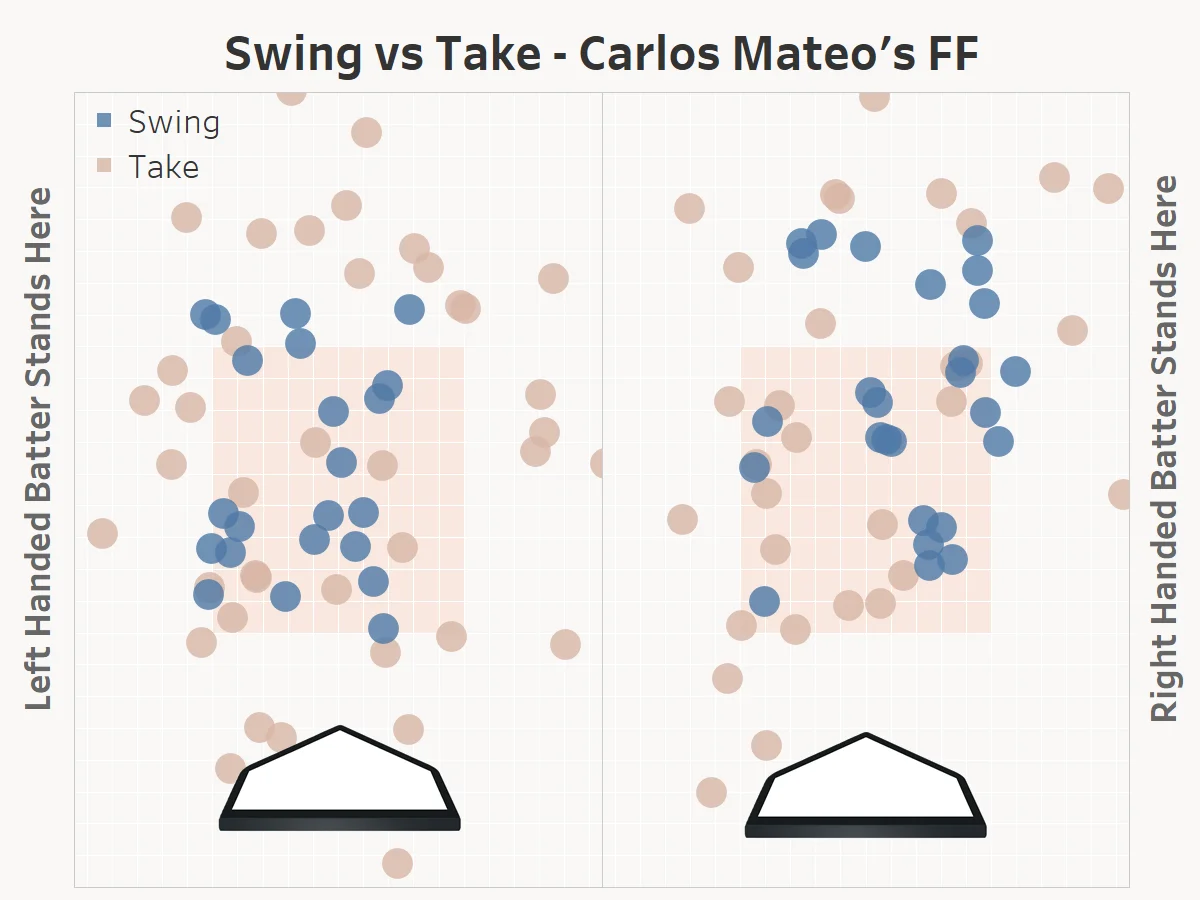
As mentioned above, good enough for Mateo means simply getting it in the zone. When he locates it well and gets a swing, batters basically can’t touch it:
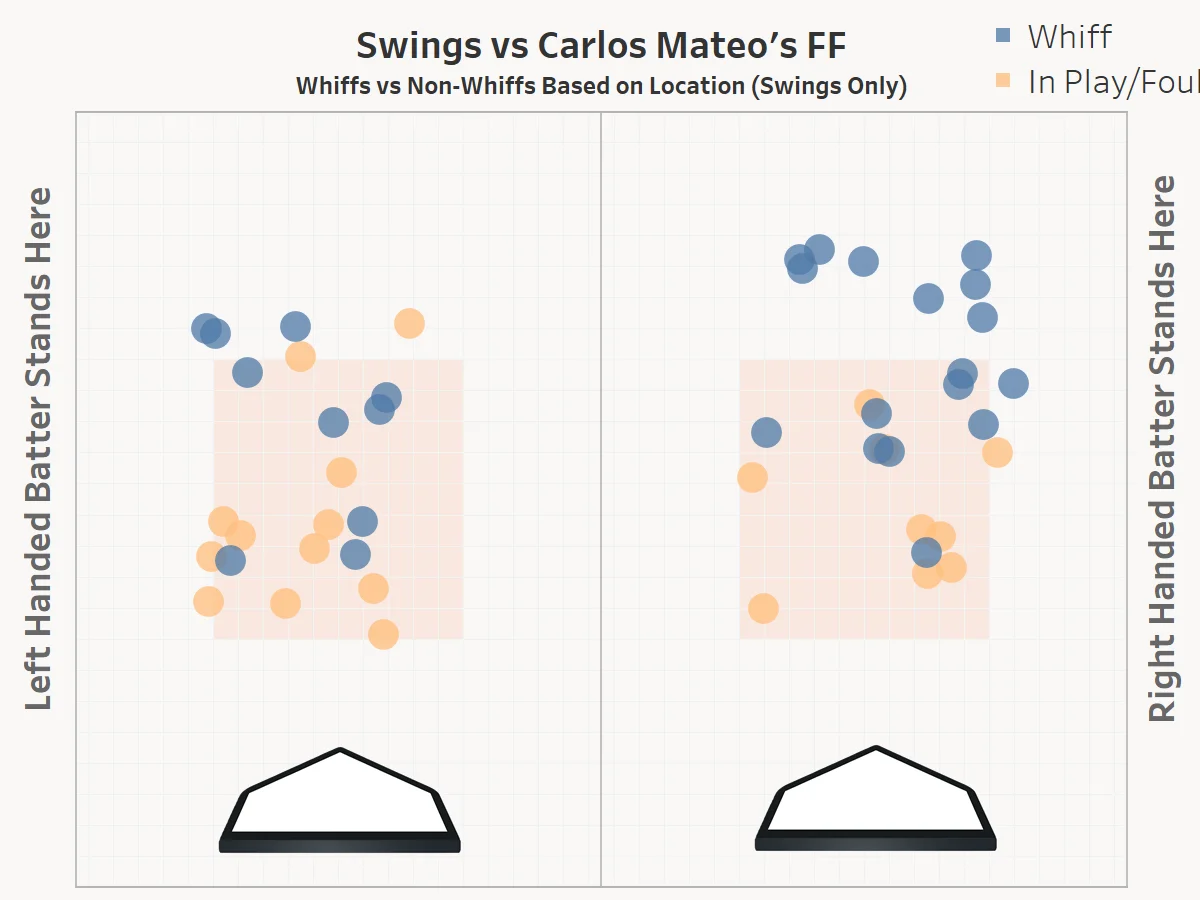
That’s a 100% whiff rate on pitches at the very top of the zone or higher against righties. If we lower that to roughly the top third of the zone, it’s 14 whiffs on 15 swings against righties and seven whiffs on nine swings against lefties. Given the metrics on the fastball, that sounds about right. We also see a couple of whiffs middle-middle.
It’s important to note that pitchers who have had Mateo’s early-career command woes don’t usually develop enough command to be effective major leaguers. But when they do, they become impact players.
JoJo Parker, SS/3B, Blue Jays
Baseball is wonderfully eccentric. It’s the only major sport, at least among those commonly played in North America, where the game is dramatically different, merely based on which arm a pitcher throws with or which side of a plate the batter stands. In Parker’s case, that surfaces as a potential platoon risk when he faces lefthanded pitchers.
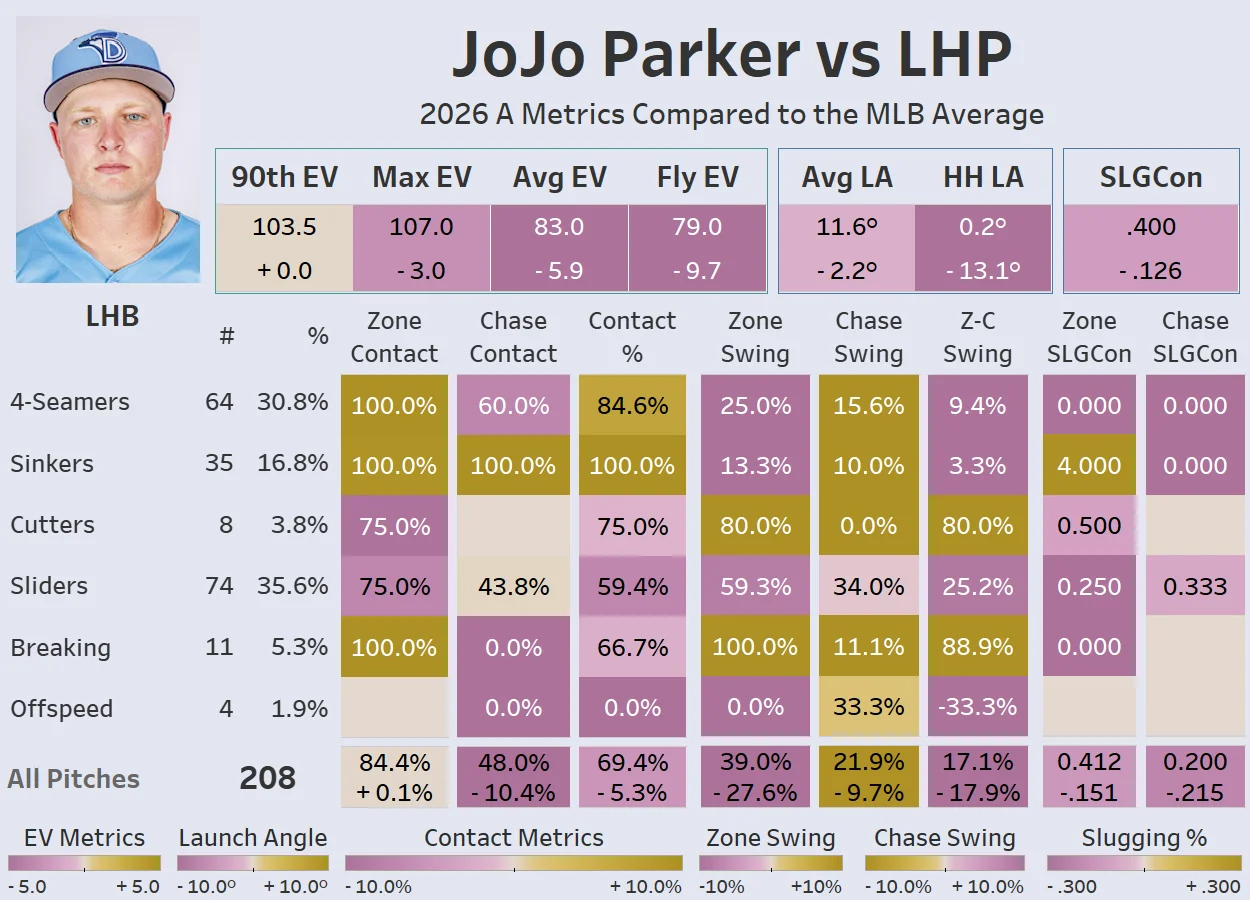
Parker’s challenges against lefties are easy to spot: He’s overly passive, barely swinging at all. When he does swing, he’s able to make contact, but it’s weak contact that’s well below his raw potential. While this doesn’t bode particularly well for his potential for avoiding a long-term platoon role, he is still very young and should be given time to work on it.
Where Parker really shines is when he has the platoon advantage against righties:
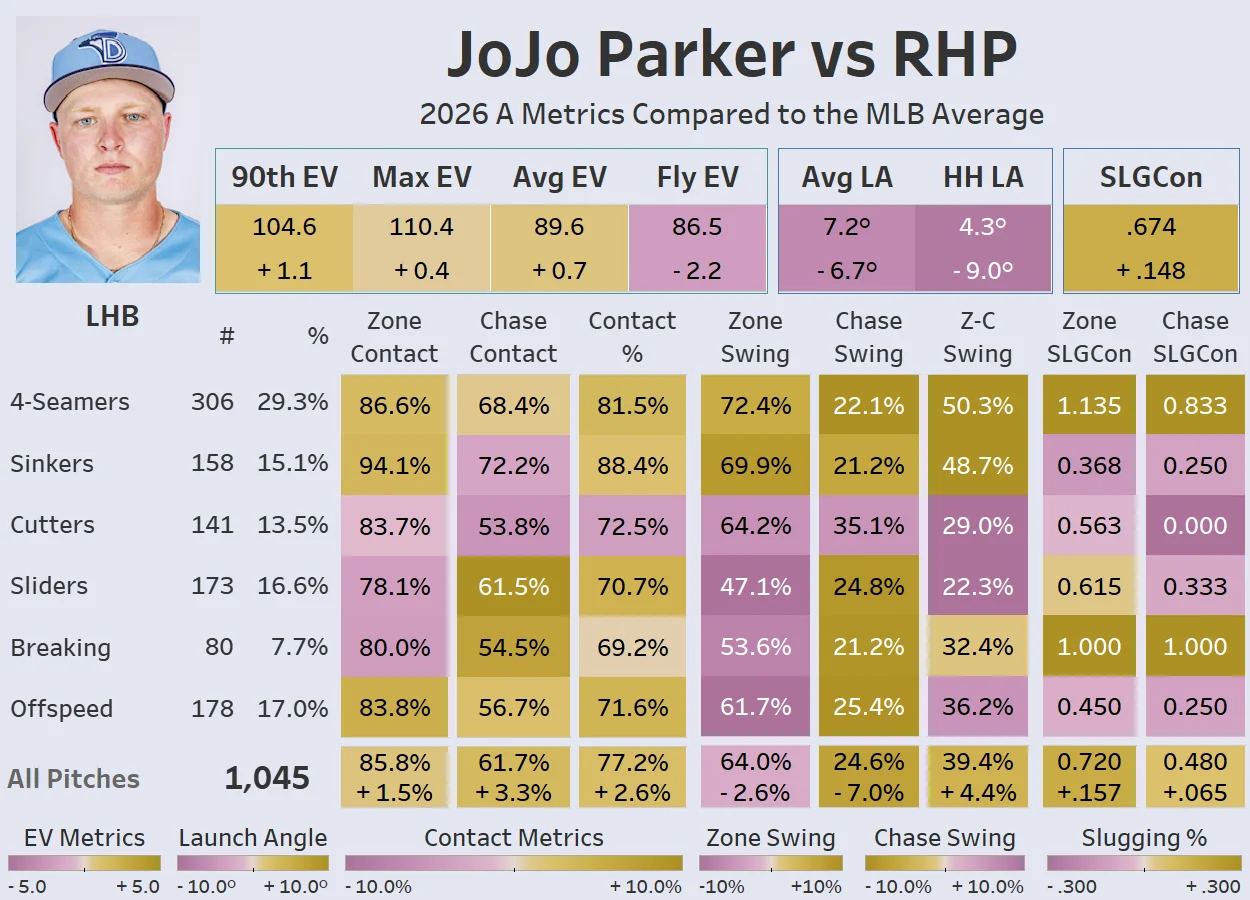
Parker maintains his selectivity against righties, but combines it with very good in-zone aggression against fastballs. He’s hunting fastballs in the zone and crushing them when he puts them in play. His combination of raw power, contact and discipline makes him a high-probability major leaguer, at least against righties. It’s not a flawless profile, given the mediocre launch angles, but it’s above average everywhere else that matters.
Let’s dig into that fastball approach some more:
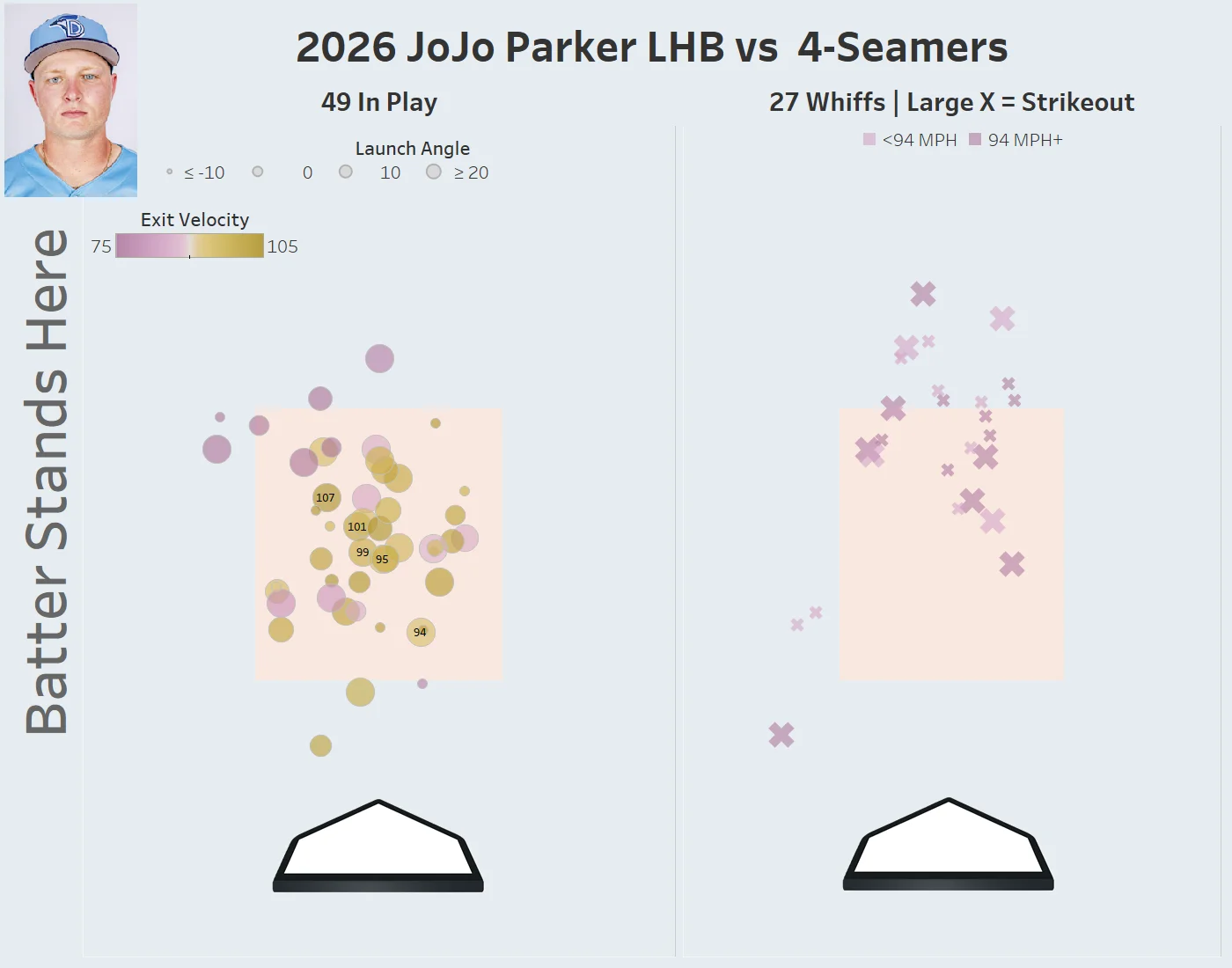
Parker’s swing isn’t yet geared to damage fastballs at the top of the zone, but he absolutely crushes any mistake pitches. He has a very clear sweet spot, so he may need to adjust his swing as he moves up the ladder. While it may look easy to target the top of the zone, he doesn’t chase above the zone very often:
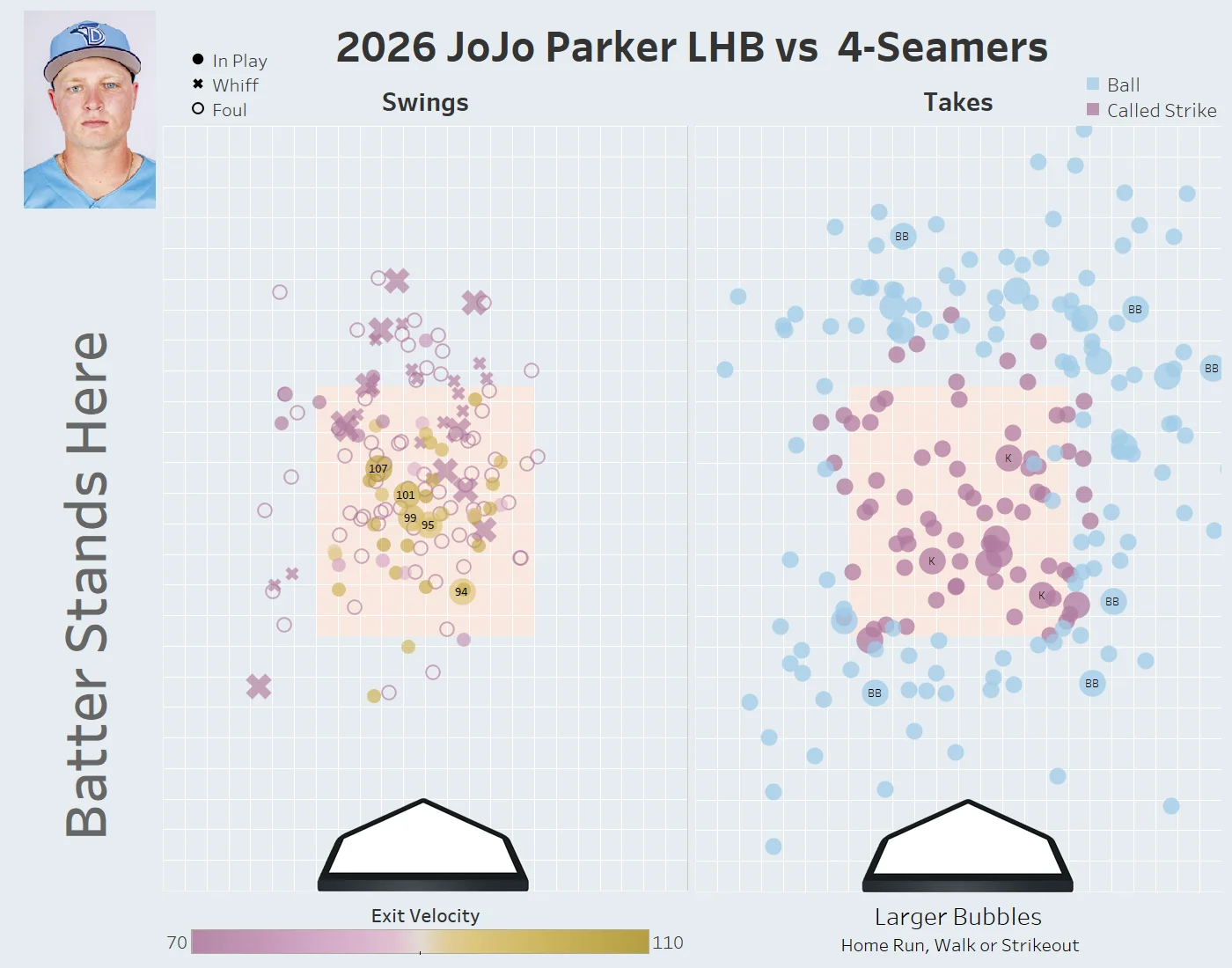
These visuals paint a clear picture of who Parker is right now in his development path: a strong hitter who can punish mistakes. He’ll force pitchers to attack him in the zone but will struggle against lefties. He’s already showing major league-quality pitch recognition, contact rates and exit velocities, with a clear set of areas where he needs to develop.
Leonardo Bernal, C, Cardinals
Bernal continues our theme of platoon variance, though in his case, he is a switch-hitter.
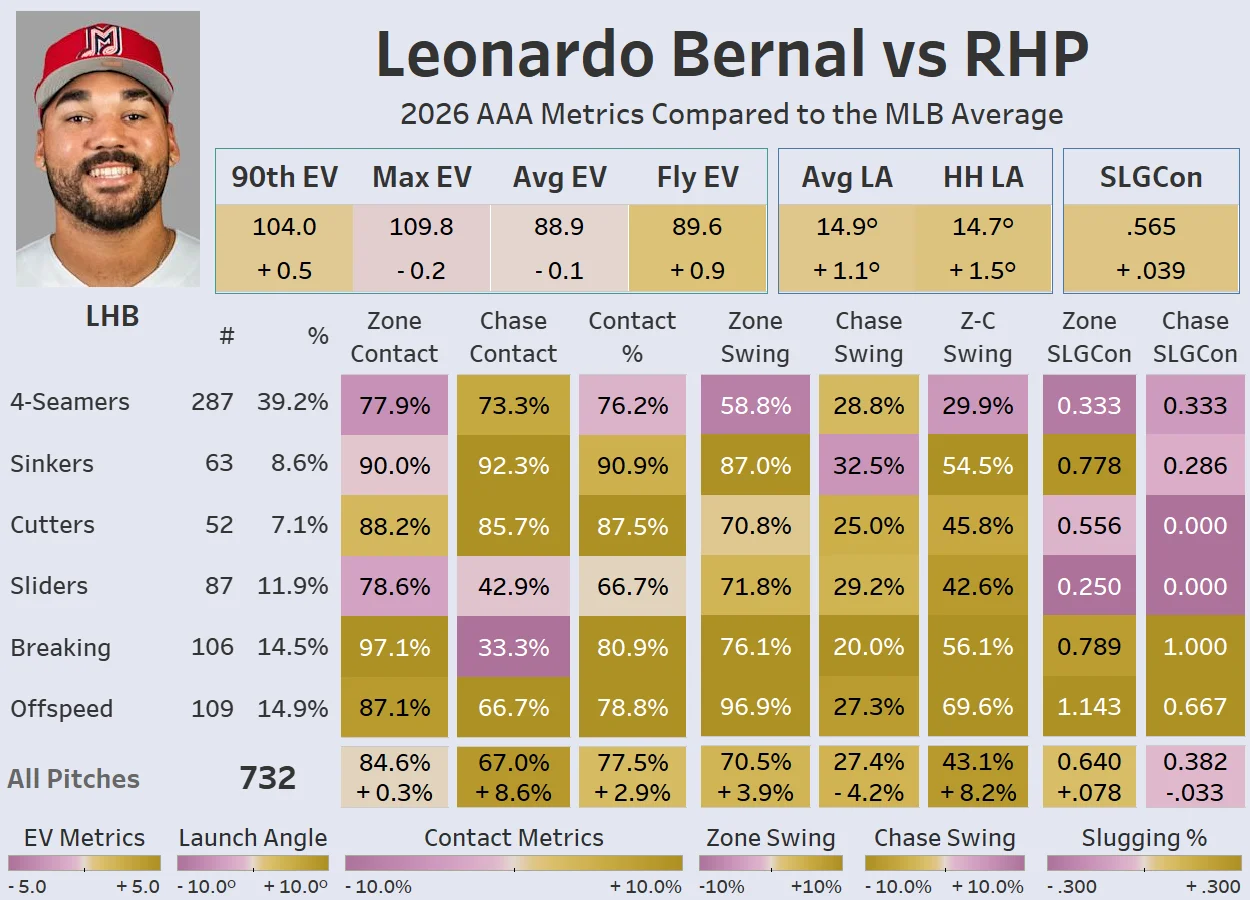
Against righties, Bernal looks like a very well-rounded hitter. Average power, tick-above-average launch angles, average contact, a very disciplined approach and no chase issues against non-fastballs. It’s not very often you see a profile this well-rounded. It’s not exciting from a ceiling standpoint, but it points to a batter with a very good shot at being roughly major league average against righties.
Against lefties, the story is decidedly different:
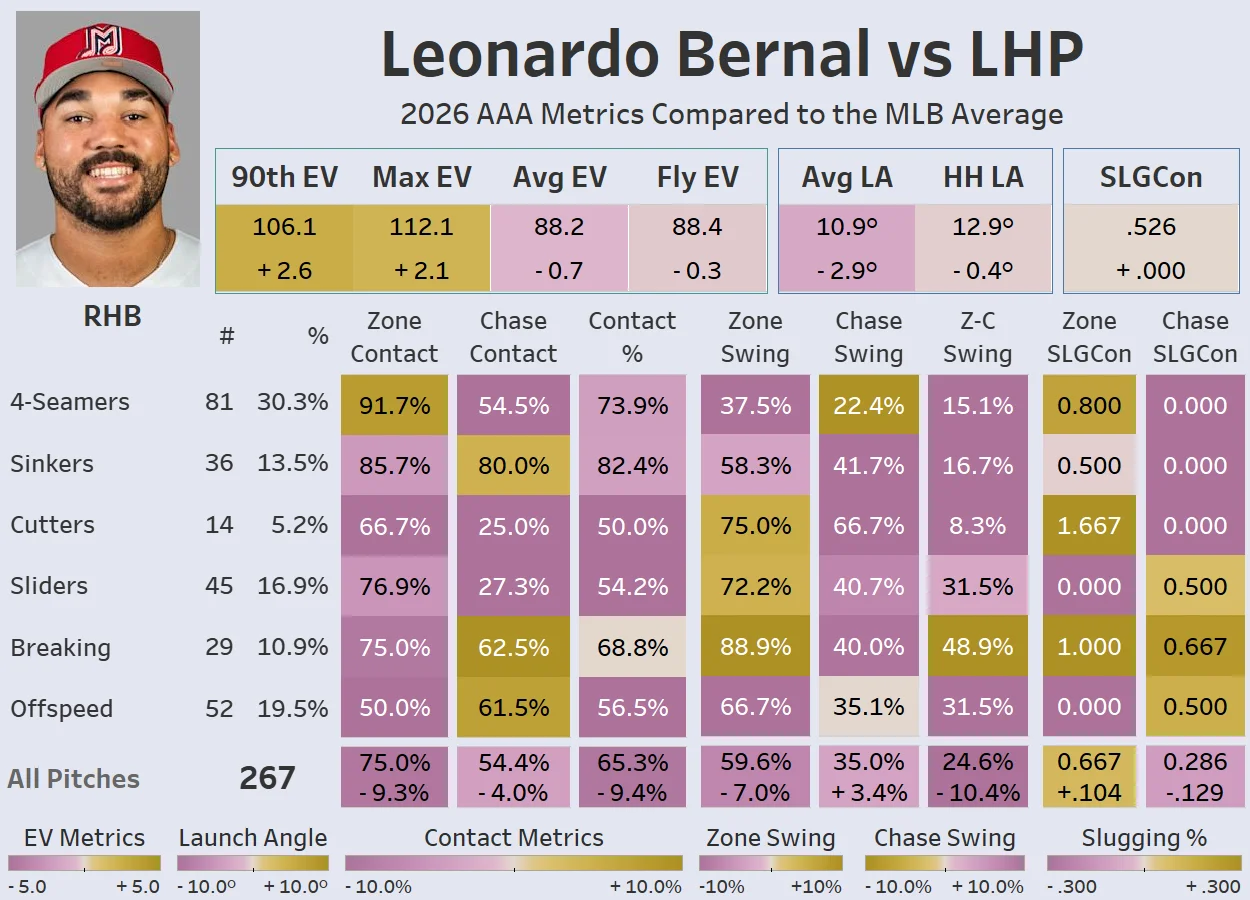
Bernal has more power from the right side, but he’s also far more aggressive in and out of the zone. It’s rather curious that his approach is so vastly different. It strongly suggests he could do a lot better against lefties if he figures out how to translate his approach to the other side of the plate. As is, his superior bat speed from the right side gives him more upside against lefties.
Cade Dana, RHP, Angels
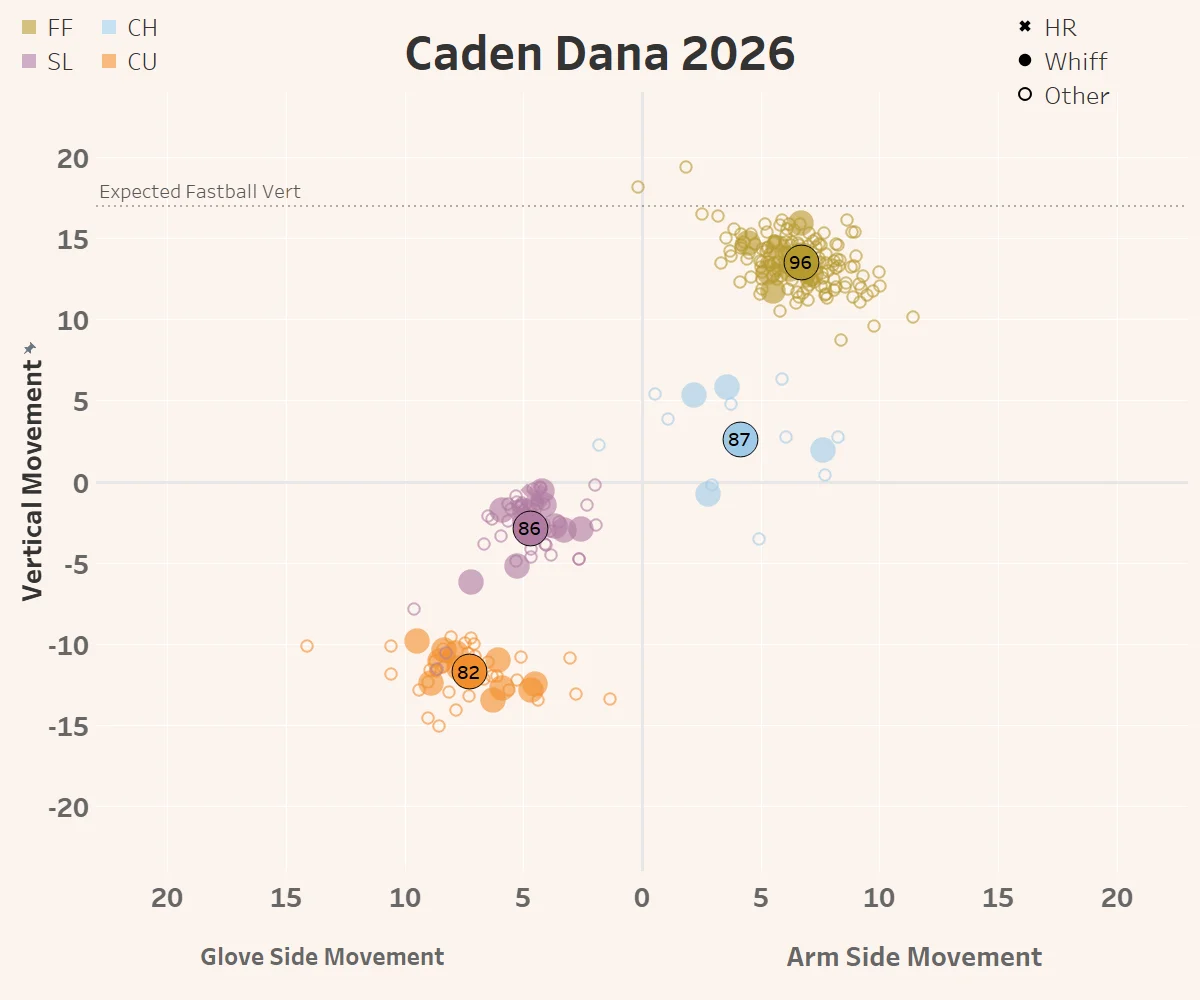
Dana’s arsenal is calling out for some pitch design magic. He has the raw ingredients to be a successful major league arm: good fastball velocity and quality swing-and-miss secondaries.
Dana’s best pitch is his curveball. He added 3-4 mph on the pitch and upped the spin rate while keeping a good shape. His whiff/swing rate on the pitch spiked to 66.7%, along with 23.5% whiffs/pitch. That’s a plus to plus-plus secondary he’s comfortable throwing often. His slider has deathball shape almost and should perform even better than it has, but it’s mostly just been “good” rather than “great”.
The weirder year-to-year switch has been with Dana’s changeup, which is now a splitter. Batters aren’t chasing it nearly as much as they did with his 2025 version. That likely points to him not being able to sell it as effectively, even if it would theoretically grade better from a stuff standpoint. He may be better off throwing last year’s version.
That brings us to the fastball. Despite good velocity at 96 mph, the pitch doesn’t get nearly enough ride, making it an easy pitch for hitters to barrel up. Dana’s pitch data points to a pitcher that doesn’t have a strong ability to pronate (good for vertical fastballs) nor a strong ability to supinate (good for sinkers/sweepers).
A viable roadmap for Dana would be to follow in the footsteps of Nathan Eovaldi. Eovaldi throws his fastball only 12% of the time and uses a hard cutter at 90-91 mph as his primary hard pitch. He also developed a sinker, which he mixes in about 9% of the time. It doesn’t have tremendous shape or velocity, but it is very effective within the arsenal.
Dana could transform himself into a midrotation-or-better starter by adding a cutter and sinker and dropping the fastball usage into the low single digits. Further development of the change/split would help a lot, as well. Don’t write him off just yet, he’s got the ingredients to blossom into a very good rotation piece.
Max Anderson, 2B, Tigers
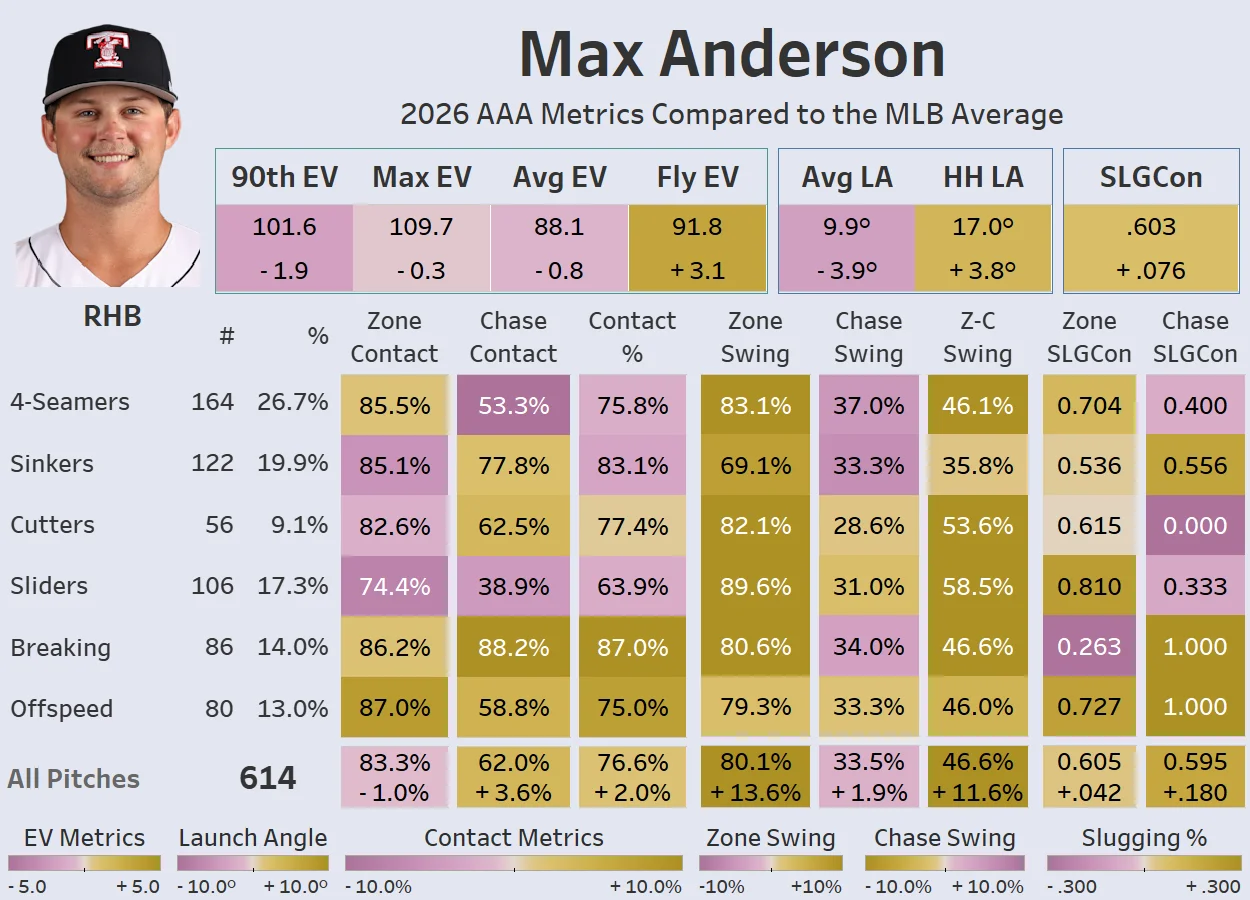
Anderson is very quietly putting up a .309/.352/.528 slash line in Triple-A, good for a well-above-average wRC+ of 130. That tracks with his 2025 Double-A slash line of .306/.358/.499, which translated to a 146 wRC+.
The reason that Anderson has flown under the radar is that he doesn’t have loud tools. His raw power is closer to a 40 than a 50. He makes contact, but it’s mostly average. He’s aggressive, but not too aggressive, and he’s a fringy defender with an average frame.
So, how does he produce the way he does? We only need to look as far as flyball average exit velocity and the hard-hit launch angles. Through 43 games at Triple-A, Anderson is demonstrating a highly optimized approach in which he goes from 45-grade power on average to potentially 60-grade power when he lifts the ball. That’s a potent combination and a rather unusual one for a player with his raw power.
Time will tell if it’s a small-sample fluke or a true skill that will translate to the major leagues.
Lluveres Severino, RHP, Blue Jays
Severino’s story is fascinating. Often in this series, we’ll analyze a pitcher’s arsenal (such as with Dana above) and say something along the lines of “this pitcher should try throwing a sinker”. Let’s take a look at Severino’s arsenal last year:
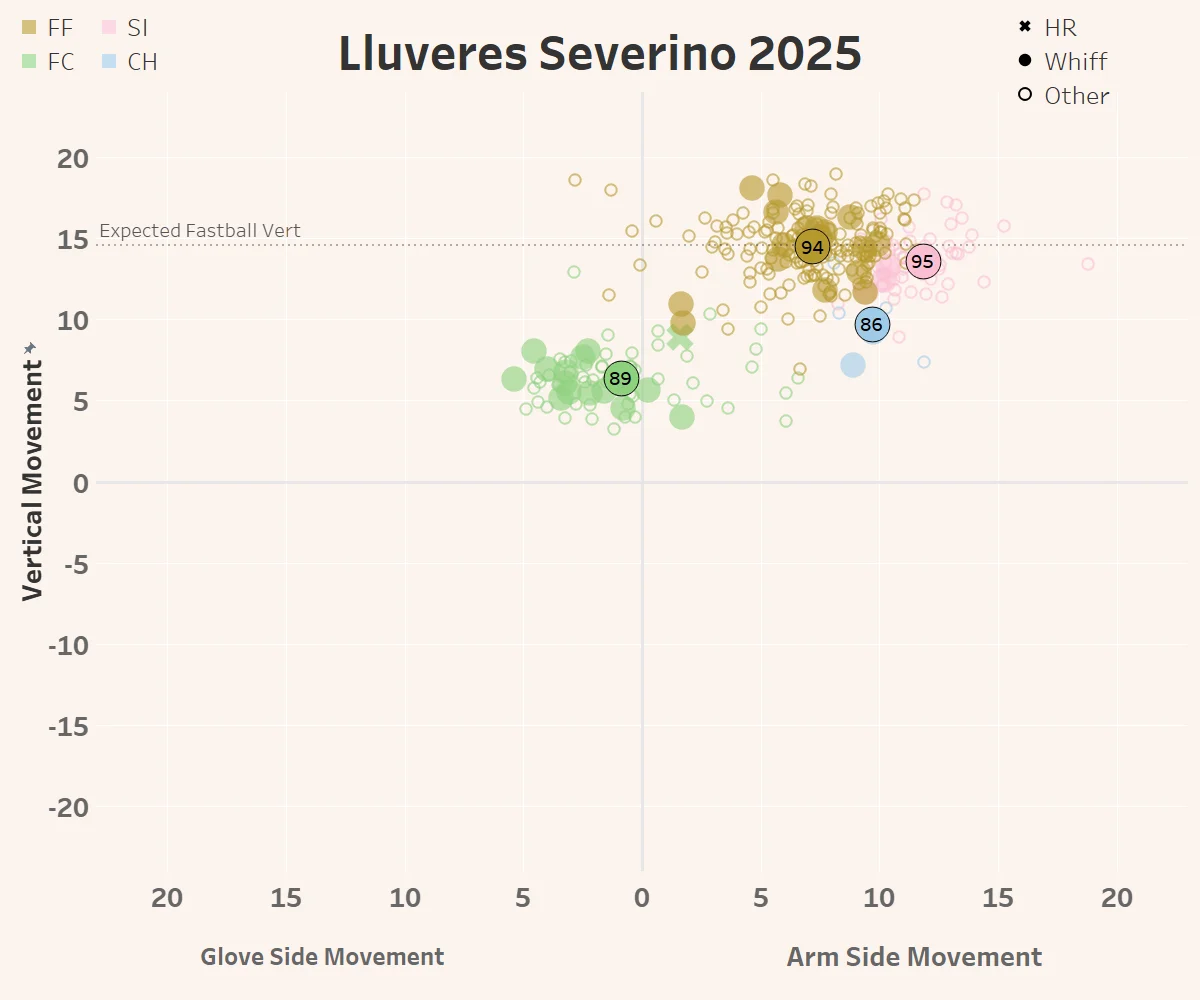
That’s a pretty average fastball with about average shape along with an 89 mph cutter. If we were writing this up last year, we’d either wish-cast some extra ride for the fastball or suggest he switches to a sinker or hard cutter closer to his max fastball velo with a little more vertical movement.
Fast forward to 2026 and voila… a delicious, nutritious, bowling-ball sinker with heavy seam-shifted wake drop:
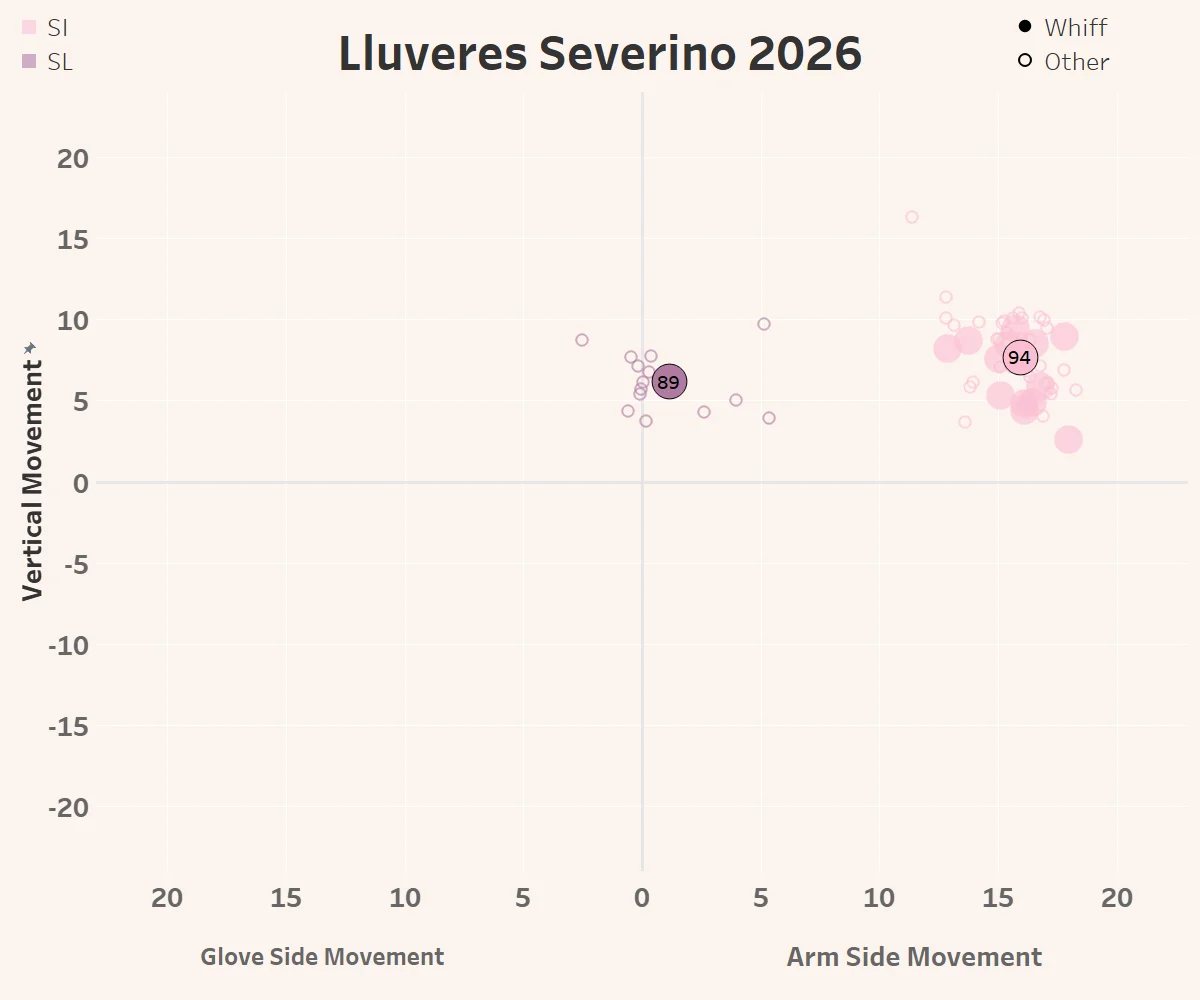
Severino completely ditched the four seamer and has turned to the sinker as his primary pitch. Batters have not been able to lift it, averaging a -5.5 degrees average launch angle, as well as a surprisingly good 38% whiff rate—rare for a true sinker. He’s struggling to command the pitch, throwing it in the zone only 36% of the time, but the stuff quality is now promising.
The rest of the arsenal is rather bare. He still has the cutter, but it’s not a huge swing-and-miss pitch. He mixes in a changeup now and then, but he’s only thrown 25 all season. The sinker is a massive development, which raises his prospects substantially, but he’ll need to improve his command of the pitch and develop a proper seam-shifted wake changeup to pair with it.
Matthew Etzel, OF, Marlins
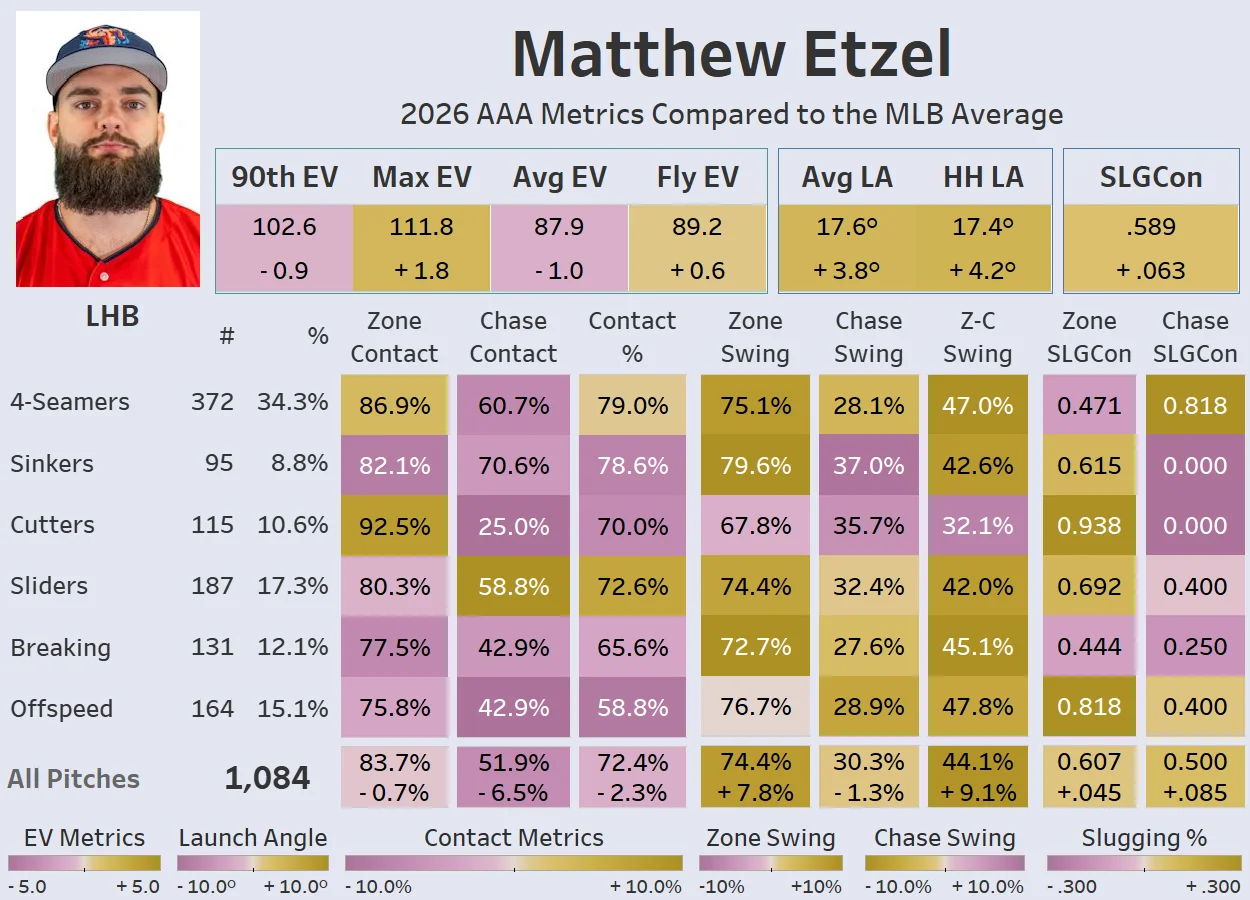
Etzel is like a more patient version of Max Anderson, with perhaps a tick more raw power. He gets by with a superb approach, enough in-zone contact and great launch angles that allow him to sneak a few home runs here and there. The overall profile includes his less-than-stellar numbers against lefties, so let’s drill down on his likely platoon-only numbers:
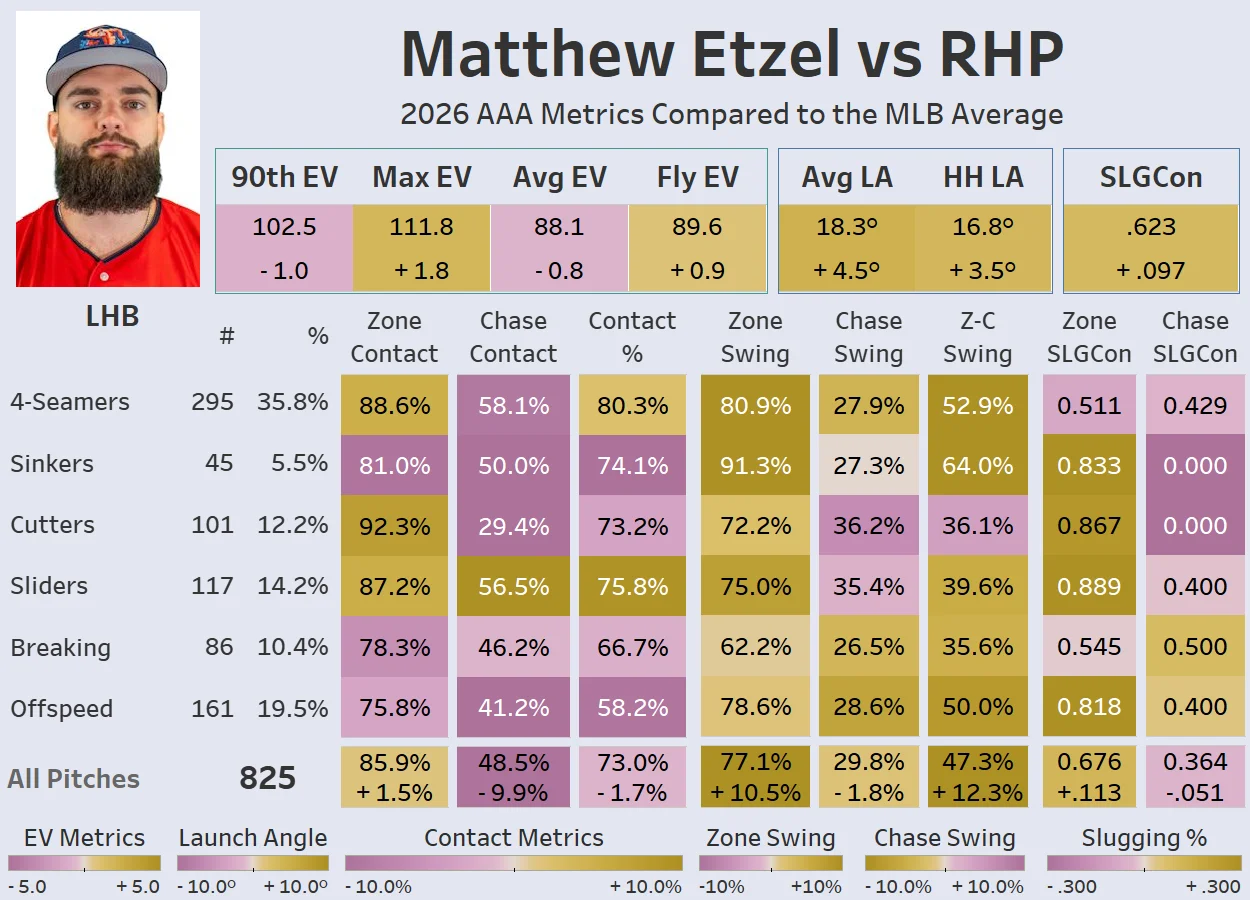
The story is largely the same, but it now paints a clearer picture of a good-contact, great-approach, good-power type of bat. That should round out to an average-or-better hitter against righties in the major leagues. Deep teams tend to stack a lot of these types of players.
William Kempner, RHP, Marlins
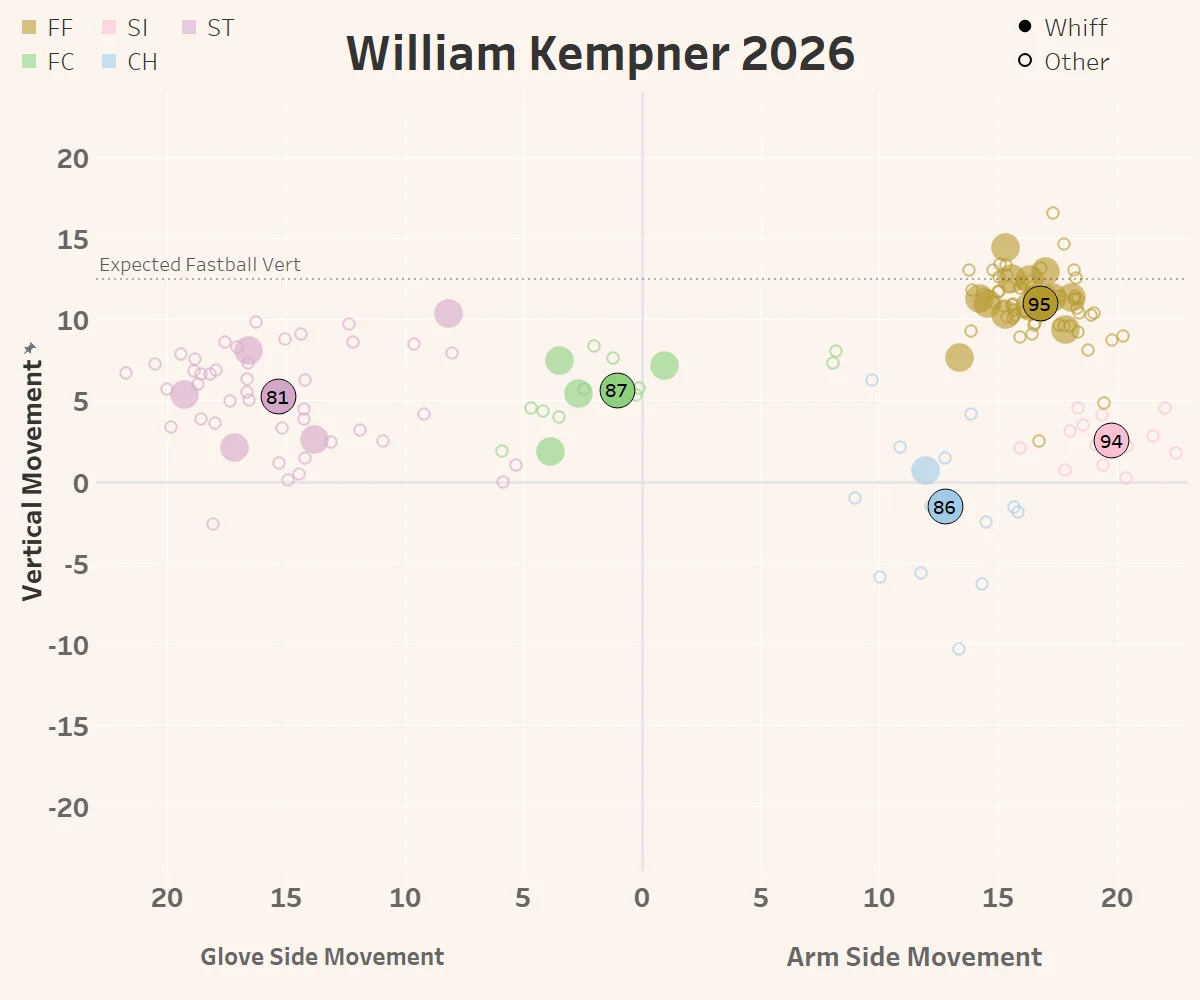
Seam-shifted wake effects are dependent on pitch types. For a sinker, that usually drives the ball down and to the arm side. For a sweeper, it does the exact opposite—it pushes the ball glove side and lifts the ball. This creates the unusual effect of causing batters to swing under a breaking ball, rather than over it, like a traditional curve or slider.
In Kempner’s case, he gets huge amounts of lift on the ball, and batters are almost always underneath it, averaging a launch angle of 35.7 degrees on the pitch in Triple-A and 24 degrees in his short stint in the majors this year. Conversely, his sinker is diving under bats and holding batters to a four-degree average launch angle.
Because his sinker/sweeper pair is so potent, his otherwise pedestrian fastball plays up, with a very good swinging-strike rate of 17.7%, which he nearly matched in the majors. He rounds it out with a bridge cutter and a developing splitter.
This is, without a doubt, a complete starter’s arsenal. He’s been mostly deployed as a relief pitcher, as he’s struggled to throw either fastball in the zone. He could benefit from being deployed full-time as a starter in Triple-A, with the hope that more reps will lead to an uptick in command.
Joshua Kuroda-Grauer, SS, Athletics
Let’s begin with an excerpt of Kuroda-Grauer’s scouting report:
“He’s an above-average shortstop with sure hands, a quick exchange and an accurate arm, and he adapted seamlessly to second and third base after Leo De Vries’ promotion to Double-A … In the absence of more power, Kuroda-Grauer might be best suited for a super utility role in which he can provide contact and on-base skills at the bottom of a lineup and add value defensively.”
Let’s take a look at what he looks like now, and see if the 30-grade power from his report is trending upwards:
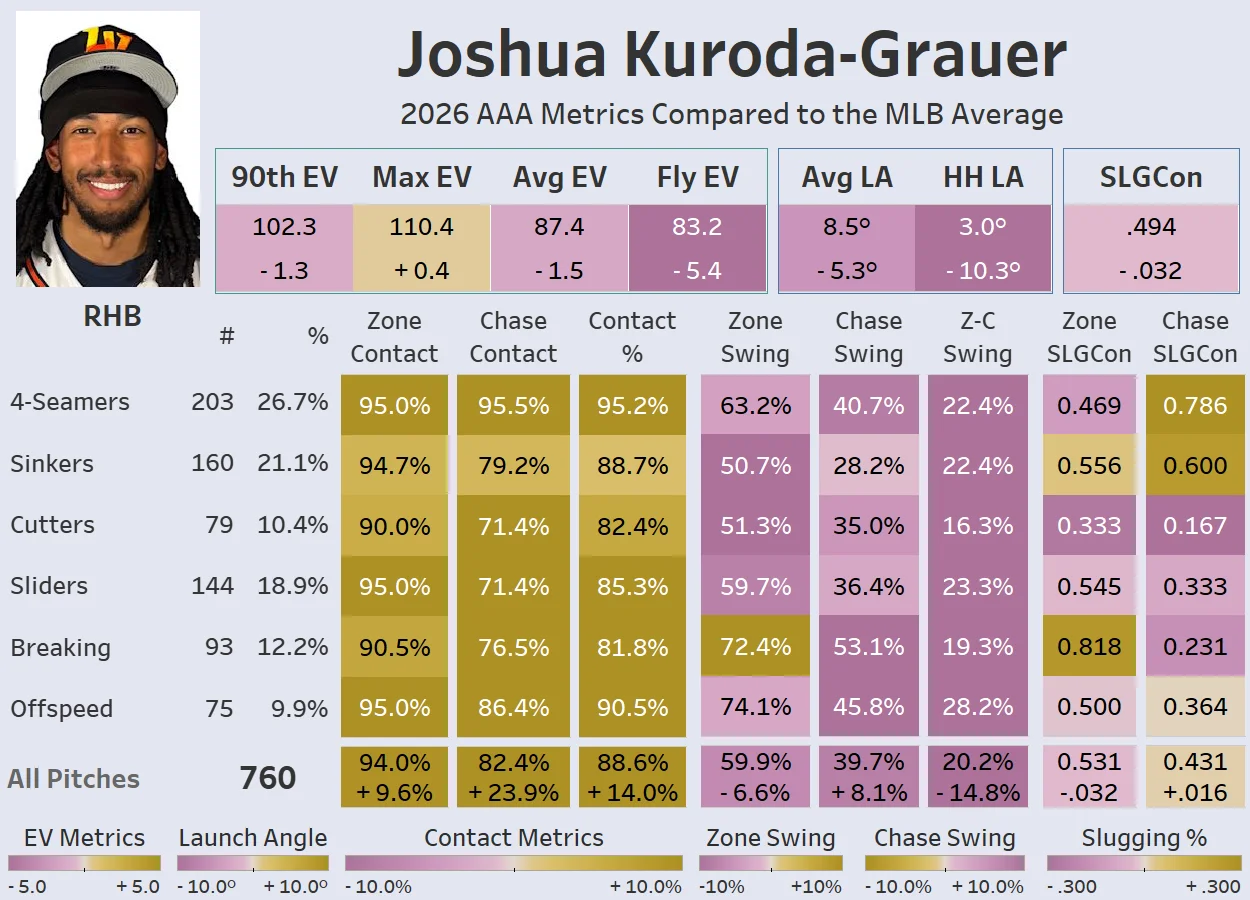
The answer is “maybe”. His maximum EV certainly suggests 50-grade raw power, but his launch angles, average exit velocities and 90th percentile exit velocity all suggest power grades between 30 and 40. If we buy into the max, we could perhaps revise his grade to a 40.
Where Kuroda-Grauer shines is his superlative bat-to-ball. He’s far too aggressive, but despite that, he manages to make a ton of contact in and out of zone. In fact, his chase contact rate would be an above-average in-zone contact rate—that’s how good it is. He also does a decent job not wasting that contact. It suggests he might be the rare exception who can succeed with a swing-at-everything approach, though he would benefit substantially from more selectivity.
Kuroda-Grauer is definitely a name to know, given the defensive chops and plus-plus bat to ball. If the power is truly a 50, as suggested by the max EV, he may even have some sneaky upside.
College Pitcher Spotlight
Tanner Bradley, RHP, Oregon (Unranked on BA’s 2027 College Draft Board)
Bradley was named to BA’s College Baseball All-America team, and it’s easy to see why. Pitching out of the pen, he struck out 84 batters in 54 innings, good for a 38.9% k% which was 5th best in the country. What makes him intriguing is that he might just be starter material.
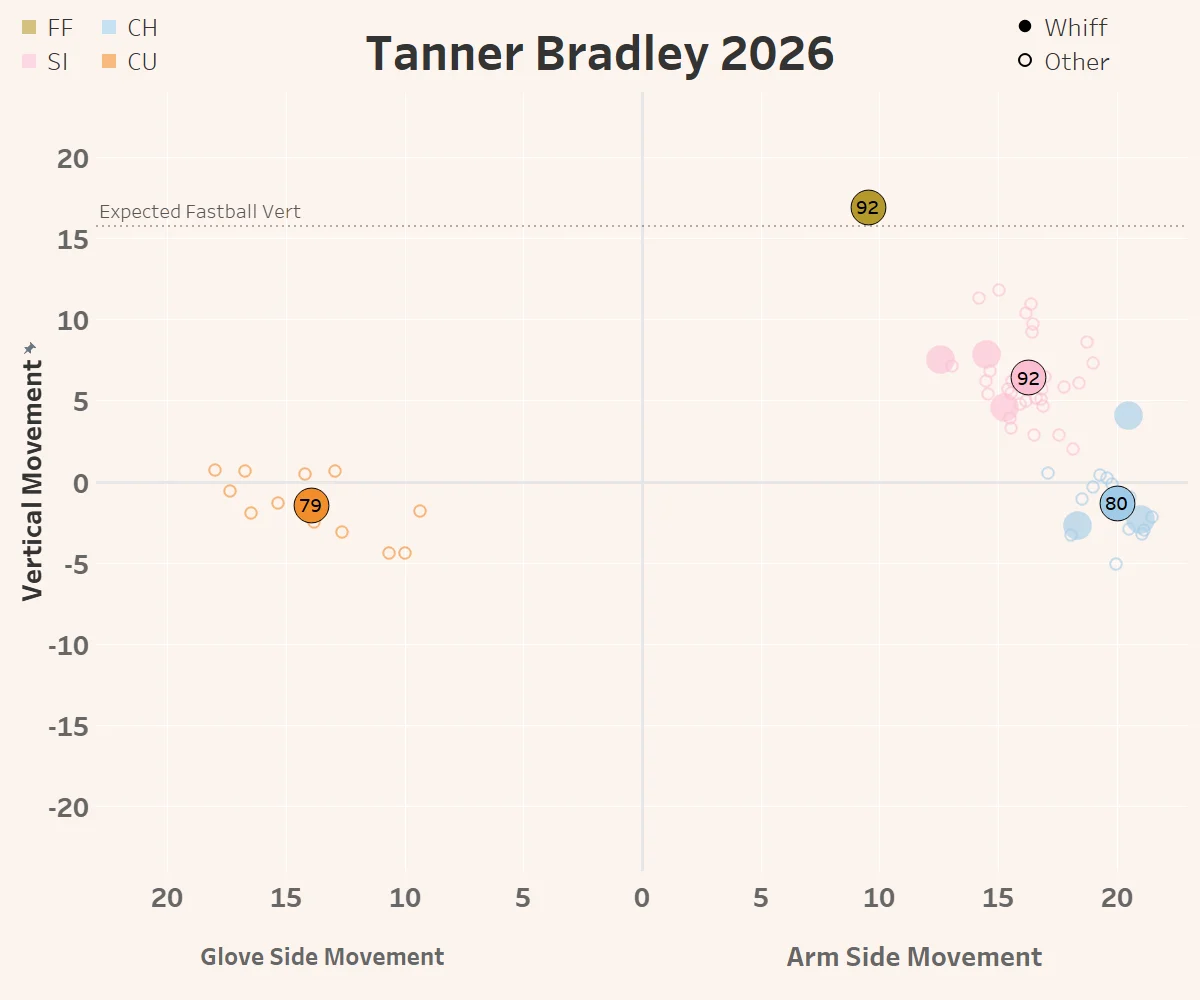
Bradley’s the prototypical supinator, dominating with extreme east/west movement. Sinkerballers of this archetype are often guys who don’t get a ton of swing-and-miss. That’s not the case for Bradley, who may be the rare sinker/sweeper/changeup pitcher who can also miss bats.
The sinker likely has room for improvement and might be able to get more depth, but it’s solid enough as is, with a little projection for the velocity. With a smidge more seam-shifted wake movement and a couple ticks of velocity, the sinker jumps into plus territory. The hard part is commanding a pitch that moves this much, which he’s shown the ability to do already.
Bradley’s changeup, meanwhile, is mind-bending. It gets over 20 inches of run, with negative vertical movement. That’s a fantastic shape and could be good enough that he can use it against both righties and lefties. The sweeper isn’t quite as deadly, lacking the premium spin qualities that would make it a dominant pitch. If Bradley gets a chance to start next year, he could boost his draft stock for 2027 immensely.
The post Carlos Mateo, JoJo Parker Headline 10 Statcast Standouts (June 29) appeared first on College Baseball, MLB Draft, Prospects - Baseball America.
