Shakhtar Donetsk’s European matches carry a significance beyond the scoreline: they give Ukrainians a reason to gather around a screen, while the energy crews at club partner DTEK work to keep the lights on. The relationship brings football’s public reach into view alongside the less visible work of restoring power.
Empower Sports
A European campaign under extraordinary conditions
Shakhtar, which has the youngest squad in the Champions League, has already beaten AEK Athens 3-1 at Stamford Bridge. That was the first time a Ukrainian club had won on English soil. Fixtures against Sporting and Fenerbahçe in London were still ahead, with Real Madrid due in January.
The club’s route to those matches runs through a season shaped by disruption. The night before travelling to London, air raid sirens stopped Shakhtar’s league game in Rivne. Players took shelter in the stadium before later walking out at Stamford Bridge.
For CEO Serhii Palkin, the team’s role reaches beyond representing the club. Supporters at home can spend a couple of hours following a match and thinking about something else. But whether they can watch depends, for many households, on electricity and heating surviving another winter of repeated strikes on the energy system.
Repair work measured in millions of restorations
DTEK, like Shakhtar, belongs to the SCM group founded by Rinat Akhmetov. The company’s crews return to damaged facilities after missile and drone strikes to restore power. Palkin praised their work and said the club was proud to stand alongside them.
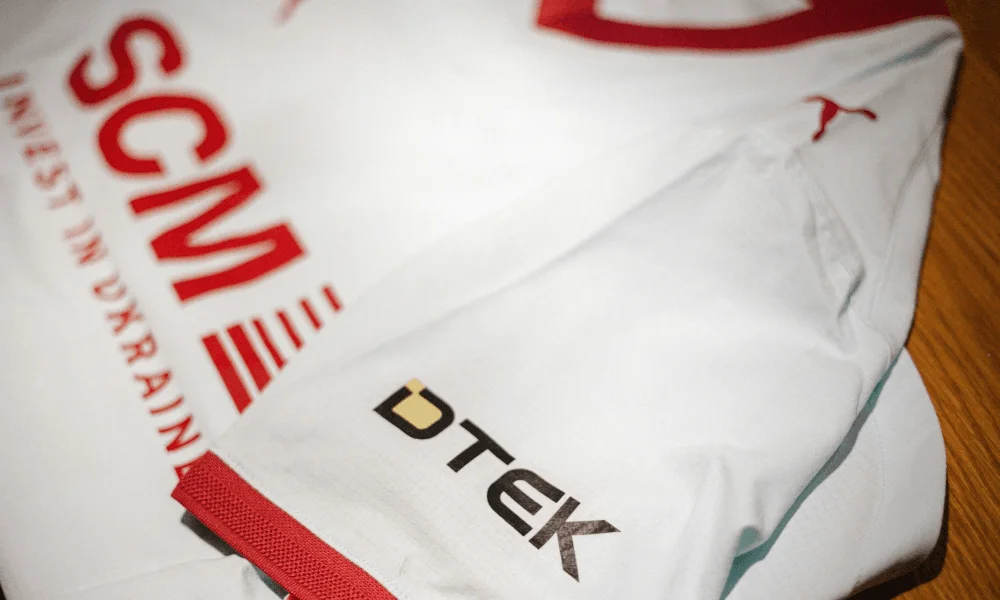
For DTEK head of strategy and DTEK Grids chairman Ivan Geliukh, the partnership has a personal dimension. Both organisations have roots in Donetsk, and Shakhtar’s name means “miner.” Many DTEK employees follow the club as part of family traditions connected to the Donbas mining and power industries. Seeing the company’s name on the team’s sleeve at Stamford Bridge matters to them, he said.
Geliukh said Russia carried out around 4,500 attacks on Ukraine’s energy system last year. DTEK’s thermal power plants have been repeatedly hit over four winters, and 484 of the company’s colleagues have been killed, either while working or defending their country.
Even so, crews keep repairing facilities that may be struck again. Since 2022, they have restored electricity to Ukrainian homes more than 56 million times, according to Geliukh. The figure conveys the scale of a job that often has to be repeated.
Designing for damage and faster recovery
The attacks have also influenced how DTEK thinks about rebuilding the energy system. Geliukh’s view is that no infrastructure can be made entirely safe from attack. Physical protection still matters, but the system also needs to keep functioning when parts are damaged and recover quickly afterward.
That points to a more decentralised network, with power sources distributed across the country. Automation and smart grids can help isolate damaged equipment and restore service to customers outside the affected area. DTEK is already applying some of those ideas: during the war, it has built Eastern Europe’s largest wind farm and Ukraine’s largest battery storage systems.
Geliukh sees those efforts as experience other European energy operators can learn from. Ukraine’s experience came at a terrible cost, but its practical lessons about decentralisation and recovery have wider relevance.
Shakhtar has represented Ukraine in European competition since it was forced from its home in Donetsk more than a decade ago. Its continued presence gives the club a role for supporters beyond sport, including the DTEK employees whose work keeps energy flowing. Football and power generation are different businesses; both depend on teams continuing to perform under pressure.
As Palkin puts it, Shakhtar gives Ukrainians a reason to turn on the television this winter. DTEK’s task is to help ensure the electricity is available when they do.
Empower Sports is a global PR agency representing clubs, executives, coaches and athletes.