Hoka’s story matters because it helped make maximal cushioning mainstream. When minimalist shoes were dominating the conversation in 2010, Hoka arrived with the Mafate, a heavily cushioned trail shoe that ultrarunners valued for its thick foam and shock absorption. The shoe offered a different answer to a familiar problem: how to manage the repeated impact of long runs over uneven ground. Other brands soon followed with high-stack designs, and what began as a distinct approach became a familiar part of running-shoe choice.
That idea now sits alongside super foams and World Athletics’ 40-millimeter stack-height limit. Hoka’s plush midsoles, roomy fit, and rocker-shaped soles appeal to runners and walkers, but the brand’s shoes aren’t interchangeable. A tall, soft midsole can feel comfortable to one runner and cumbersome to another; a rocker can encourage a smooth roll through a stride, though its effect depends on the runner and the shoe. The right pick depends on how and where you run, as well as what feels stable underfoot. Here’s our guide to the top Hoka options and what to know about the brand’s approach to cushioning.
Editor’s note, October 26, 2026: We’ve added the Arahi 9, a lightweight stability shoe with plush cushioning. The Arahi 8, a past Gear of the Year winner, is currently 20 percent off. The update highlights a useful distinction in the range: stability and softness aren’t mutually exclusive, but the feel and support of a shoe still need to suit the person wearing it.
Top 10 Best Hoka Running Shoes
The lineup’s most telling feature is its range: Hoka’s picks run from a $125 daily trainer to $275 race shoes. That gives runners options by purpose, but the labels alone don’t explain how the shoes compare in fit or feel. A “best for long runs” designation, for example, can help narrow a search, but it can’t tell you whether the shoe’s cushioning and shape match your stride. Here are the selections and listed prices:
- Best overall: Hoka Clifton 11 — $155 for men’s and women’s.
- Best value: Hoka Rincon 5 — $125 for men’s and women’s.
- Best lightweight trainer: Hoka Mach 7 — $145 for men’s and women’s.
- Best for maximum cushioning: Hoka Skyward X 2 — $225 for men’s and women’s.
- Best for stability: Hoka Arahi 9 — $155 for men’s and women’s.
- Best for road racing: Hoka Cielo X1 3.0 — $275, unisex.
- Best for long runs: Hoka Bondi 9 — $175 for men’s and women’s.
- Best overall trail shoe: Hoka Speedgoat 7 — $165 for men’s and women’s.
- Best for trail racing: Hoka Tecton X 4 — $275 for men’s and women’s.
- Best for ultramarathons: Hoka Mafate X — listed at $225 for men’s and $157 for women’s.
Runner’s World’s recommendations draw on a broad testing pool: more than 300 local wear-testers with different ages, experience levels, foot shapes, and paces. That range matters because a shoe’s ride can change with a runner’s gait, preferred fit, and typical route. A shoe that works for one kind of runner can disappoint another, and the testers’ feedback helps the editors account for those differences. It also gives the list a practical basis beyond comparing product descriptions.
Each shoe was assessed for fit, feel, and ride. Those are related but distinct questions: a shoe can fit well and still feel too soft, too firm, or awkward in motion. The picks that follow are intended for different runners and kinds of runs, so the category labels are best treated as starting points for comparison. Listed weights refer to men’s size 10 and women’s size 8 unless specified otherwise.
Full Reviews
Best Overall: Hoka Clifton 11
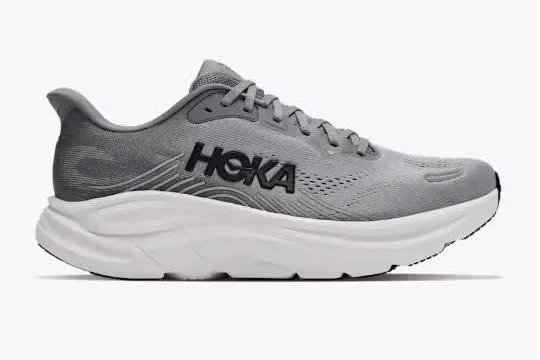
The Clifton 11 is the guide’s top overall choice, a position that suggests it serves as a broadly useful option within Hoka’s range rather than a specialist shoe for one narrow purpose. It’s listed at $155 at HOKA. The price sits above the guide’s least expensive pick and below its race models, which may make the Clifton a practical place to start for runners seeking one everyday shoe. Still, “overall” is a summary of the testing and editorial judgment, not a guarantee that its fit will suit every foot.
What the lineup says about cushioning
Hoka’s range reflects how much the conversation around running shoes has shifted since the Mafate’s arrival. Cushioning is now a design choice with trade-offs, not a single measure of comfort: more foam may appeal to runners seeking a plush ride, while a lighter trainer or race shoe serves a different purpose. The brand’s history gives its high-stack shoes a clear identity, but it doesn’t mean every runner should choose the softest or tallest option.
That’s the useful context behind a list spanning daily trainers, stability shoes, road racers, and trail models. The names and categories help organize the choices, while the prices show a meaningful spread between an entry point and the most expensive picks. This is more significant than it looks: a brand can own a recognizable silhouette and still ask shoppers to make careful distinctions between models.
If you’re working in this space, or simply trying to choose a shoe for regular use, start with where you’ll run and what you want the shoe to do. Then consider fit and ride, since broad claims about cushioning can’t settle those questions for you. The rankings can narrow the field; trying the shoe remains the more personal test. And this is the part most people overlook: a strong recommendation is useful only when its intended use matches yours.
What to watch in future updates
The guide’s addition of the Arahi 9 shows why these lists need regular review: a new model can alter the options available within a familiar category, while a previous version may remain relevant when its price changes. That said, a lower listed price alone doesn’t tell you whether an older shoe is the better fit. The article’s own comparison points—purpose, fit, feel, and ride—remain the sensible way to judge the range.
Hoka helped make maximal cushioning a mainstream choice, and its current lineup shows how broad that category has become. But the brand’s appeal rests on more than thick foam. A rocker-shaped sole, a roomy fit, and the intended use all shape the experience. Plenty to compare.