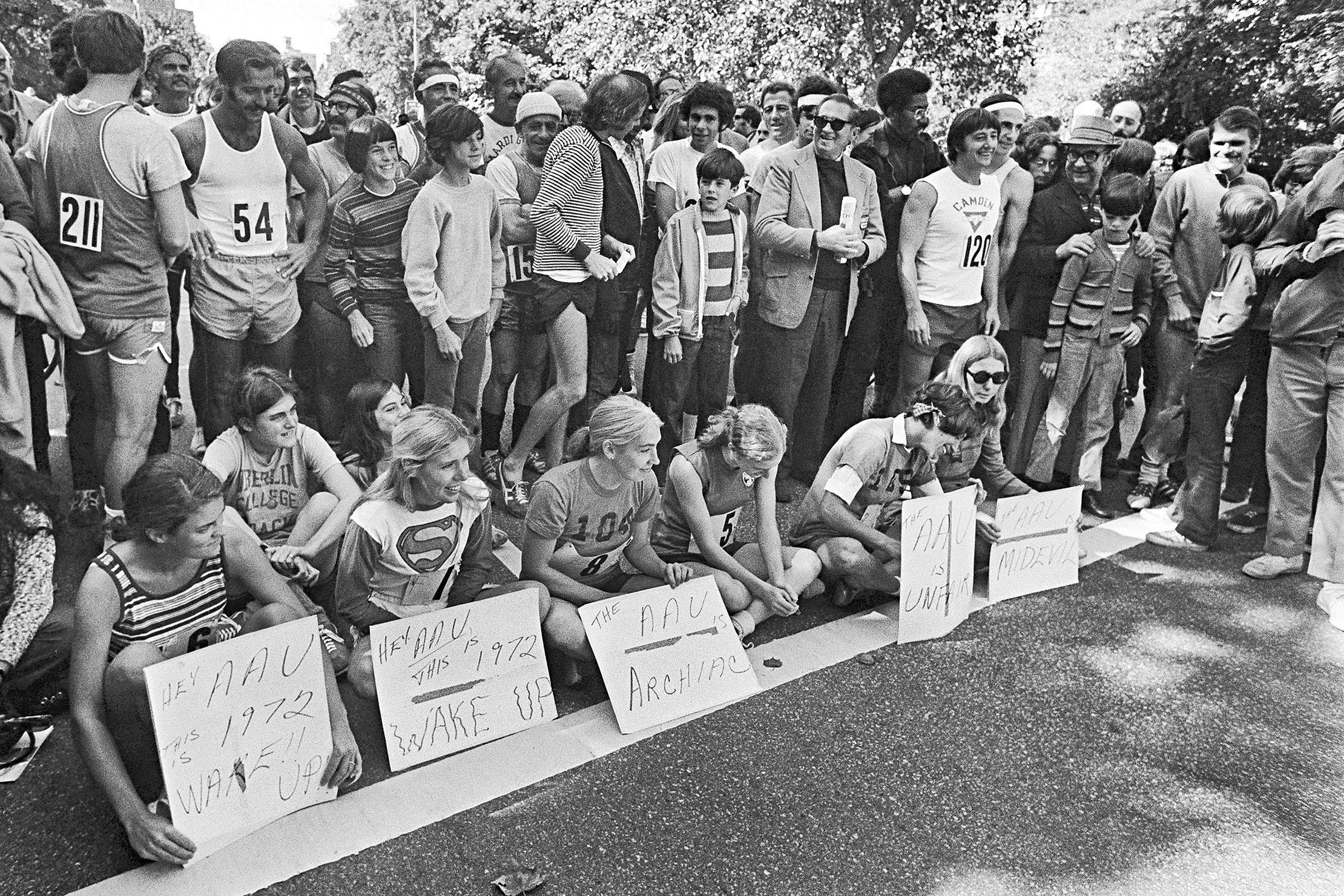
From a casual first lap in 1973 to 49 consecutive New York City Marathons, Dave Obelkevich shares lessons from a lifetime on the course.
Dave Obelkevich’s 50-year connection to the New York City Marathon is a story of changing goals: first, just keeping up; now, making it to the finish and enjoying the day. Along the way, he learned the course, built a running community, and collected advice that’s practical precisely because it comes from someone who has seen the race from so many angles.
From a 43-minute lap to a 50th start
Obelkevich first encountered the [New York City Marathon](https://www.runnersworld.com/news/a73474083/2026-nyc-marathon-elite-field-announced/) in 1973. Fewer than 400 runners were racing, and the entire event took place in Central Park. Near 100th Street on Manhattan’s Upper West Side, he watched a fast-moving pack pass and asked spectators what was happening.
“It’s the marathon,” they told him.
A recreational runner, he was impressed by the leaders but knew he couldn’t match their pace for 26.2 miles. One loop of the park seemed possible. He joined the runners for their final lap and finished it in 43 minutes. Then he signed up for the next year.
His preparation for the 1974 race was sparse: one six-mile run each week, followed by six days off. “I took six days off,” he says, laughing. He finished in 4:20:27, though he remembers the race as “tough.” The following year, he started strong but had repeated dizzy spells. With five miles left, he stopped to rest. Fred Lebow, the marathon’s late race director and cofounder, drove past, and Obelkevich asked for a lift to the finish.
“He should have said, ‘Hell no, you finish by walking!’ But instead, he said, ‘Yeah, get in the back.’ So it’s his fault I didn’t finish,” Obelkevich jokes.
The 1976 race brought a different kind of discovery. The course now crossed all five boroughs, taking Obelkevich through parts of New York he’d never seen. Raised in a suburb of Binghamton, he had moved to Manhattan in 1961 to attend Columbia University and had always lived on the Upper West Side. Staten Island, he recalls, was entirely new to him.
By then, he had joined the Millrose Athletic Association and built better [training habits](https://www.runnersworld.com/training/a73487354/marathon-training-minimum-readiness/), along with a new social circle. Running with people who understood the same goals and frustrations brought out a more outgoing side. “I opened my mouth and spoke to a complete stranger. It’s not that hard to do. It’s just a matter of getting started. So that changed my whole personality,” he says. He finished the 1976 race in 3:22:44.
In 1979, he broke three hours, running 2:50:18. Since 1976, he hasn’t missed a New York City Marathon. That gives him the longest recorded streak, at 49 races, and this November he’ll mark his 50th anniversary with the race in its five-borough form.
The scale has changed dramatically. The 1976 field had just over 2,000 participants; today, the event draws nearly 60,000 runners from around the world. Obelkevich remembers the early races as largely northeastern affairs. Now, he says, about a quarter of runners come from another country. He finds the event more inclusive and interesting.
His own race has changed, too. After a life-threatening aneurysm in his left leg, he recovered but never regained his former running capacity; a few minutes of running now leave him winded. He walks the course with [Athletes with Disabilities (AWD)](https://www.nyrr.org/tcsnycmarathon/athletes-with-disabilities), and his daughter, who has raced with him before, will guide him.
His current preparation is built around [physical therapy exercises](https://www.runnersworld.com/health-injuries/a44364703/prehab-for-runners/) and [walking](https://www.runnersworld.com/beginner/a69611508/science-backed-benefits-of-walking-daily/) almost every day. His longest walk in this training cycle was 15 miles. He knows some runners aim for several 20-mile sessions, but at three miles per hour, he says, those walks take a long time.
He also treats rest as part of [avoiding injury](https://www.runnersworld.com/health-injuries/a65784048/avoid-injuries-during-marathon-training/). If a pain appears, he tries moving for five minutes; if it persists, he walks home. If it still hurts the next day, he stays in. His target for this year is a finish in a little over eight hours, with fun as the other half of the plan. “That’s more important than anything else for me,” he says.
What 50 years have taught him
If you’re running this year, look for Obelkevich in Staten Island. He’ll represent New York Road Runners as part of [2026 Team Inspire](https://www.nyrr.org/team-inspire), with an 8:22 a.m. start. While waiting for the race to begin, he makes a point of talking with other runners. It helps pass the time and, as he sees it, can grow your network.
“Don’t be shy about introducing yourself. Everyone has different stories,” he says. “It’s a great way to meet people and pass the time. Have some business cards with you. So, if you want to keep in touch with someone, you can say, ‘Here’s my card.’”
Take care on shakeout runs
New York offers plenty of organized [shakeout runs](https://www.runnersworld.com/training/a71280789/benefits-of-shakeout-run/), and a few [easy miles](https://www.runnersworld.com/training/a71677605/easy-runs-build-volume/) can loosen you up before race day. But city pavement has its own hazards: uneven sidewalks and unexpected obstacles.
Obelkevich once tripped over a misplaced barricade near the finish line the day before the marathon. He was fine, but the fall could have been catastrophic. A last-minute run isn’t worth ignoring what’s underfoot.
Make the ferry part of the day
For runners assigned to take the ferry, the ride to Staten Island is part of the New York experience. The skyline, the Statue of Liberty, and the anticipation among the passengers all make the early start feel different from an ordinary race morning.
Before he began racing with AWD, which provides a bus to the start, Obelkevich usually took the ferry and struck up conversations with runners from around the world. “That was always a lot of fun,” he says.
Bring something to read—and keep a warm layer
A newspaper can give you something to do while you wait without draining your phone battery. Obelkevich suggests bringing a copy of *The New York Times* and leaving it behind when it’s time to line up. He once planned to write a letter during the wait, but couldn’t find a mailbox; postcards may be more trouble than they’re worth.
Discardable layers can keep you warm before the start, and volunteers collect many of them for donation or recycling. Still, Obelkevich advises against throwing away every extra item. After finishing, runners have a long walk to their clothes—about a mile from the finish to the street, and farther if the subway or hotel is the destination. When you’re sweaty and depleted, the cold can hit hard.
If you tend to chill after a race, keep one light layer you can stuff into a waist pack or tie around your waist or shoulders.
Let the crowds carry you, but control your pace
Obelkevich rates the New York City Marathon a six out of 10 for difficulty. He has run marathons and ultramarathons around the world, but says New York’s crowd support softens the hard miles. Sometimes you can hear two bands at once, one in front and one behind. With roughly two million spectators cheering, he says, the pain passes faster; without them, he’d score the course much higher.
That energy has a downside: it can tempt you to [start out too fast](https://www.runnersworld.com/training/a73606899/marathon-start-pace-control/). Obelkevich uses the [talk test](https://www.runnersworld.com/training/a44869827/talk-test/) to keep his effort in check. “If you can’t talk, you’re going too fast,” he says.
Expect a quiet stretch on the Queensboro Bridge
Of the five bridges on the route, Obelkevich finds the Queensboro Bridge the most demanding. It comes around mile 15, when fatigue may already be setting in. The bridge is 3,725 feet long, but the lack of spectators makes it feel much longer. For runners who draw energy from the crowd, that silence can be a real test.
Then comes First Avenue. Thousands of [cheering spectators](https://www.runnersworld.com/races-places/a39515599/dos-donts-marathon-spectating/) line the Manhattan side, creating what’s often called a “wall of sound.” The shift is immediate.
Save enough for the finish—and the walk afterward
Obelkevich often sees runners struggle around [mile 20](https://www.runnersworld.com/training/a73512965/marathon-mental-tips/) in the Bronx. He says he has never hit the wall himself, partly because he plans to finish with energy left. He recently read about a celebrity runner who wanted to finish with “no gas in the tank,” a strategy he questions.
The finish doesn’t end the day. You still have to walk out of the park and get home, he points out, so pushing to complete exhaustion can backfire.
The course’s emotional high point for him comes at mile 24, when runners enter Central Park near 90th Street. After the boroughs and bridges, the familiar park and its crowds can feel like a homecoming. Obelkevich knows the park well from years on the Upper West Side. “I would say that, except for the finish line, which is most impressive, that’s what boosts my spirits the most—coming into Central Park,” he says.
Plan your trip home, then give yourself a day off
After the medal and the exit from the park, getting back to your hotel or home may feel harder than the map suggests. Obelkevich advises against counting on a cab: road closures make traffic difficult, even if you can book a car. Public transit is a more practical option, and its stairs can even help with [recovery](https://www.runnersworld.com/health-injuries/a74108687/marathon-recovery-strategies/).
His stair advice is unusual but specific: going down, turn around, hold the railing, and descend backward. “It’s 50 percent less painful,” he says. It may feel awkward, but New York subway riders have seen plenty.
After the race, he recommends taking about a week off from running and going for walks instead, which can support circulation without adding the same stress. Then celebrate. Obelkevich plans to have dinner at home with his wife, Lyn, and their family after a hot shower. The menu isn’t fixed. The beer is: “Beer is very important,” he says. His usual choice is Miller Lite. “Just one. But one beer is very important.”