Like many runners, I prefer clocking miles to lifting weights. So when I do strength train, I like to turn to exercises that maximize payoffs in the shortest amount of time. I often wonder, “If I only do a single strength exercise, which one should it be?”
A study of marathon runners, published in the Clinical Journal of Sport Medicine, provides at least some of that answer.
Before we get into the research, let’s confirm why we need strength workouts in the first place. (I always love the reminder!)
Strength training has been shown to improve running performance, particularly when it comes to running economy, or how fast you can run using a given amount of oxygen. (Translation: It helps you run faster with less effort because it makes you more efficient.)
Beyond running gains, strength workouts also help preserve and build muscle mass, support metabolic and cardiac health, and reduce symptoms of depression and anxiety. While research is mixed on strength training to prevent running injuries, it can help shore up weak spots, like the glutes or calves, and science links these weaknesses to running-related injuries.
To help you build strength where you need it most and sidestep aches and pains, one exercise appears to offer greater benefits than others.
The Best Strength Move for Runners
To figure out the must-do move for runners, researchers followed 867 participants training for the New York City Marathon. Sixteen weeks before the race, runners performed a series of self-assessment exercises at home to test their strength and flexibility, including a sit-and-reach test, side planks, single-leg glute bridges, heel raises, and push-ups.
Throughout marathon training, researchers tracked which runners developed overuse injuries, and about 36 percent of participants got one. Heather Milton, CSCS, a clinical exercise physiologist and founder of Stronger With Science, says this percentage is in line with published injury rates—between 30 and 50 percent—among marathon runners.
Based on the series of exercises the marathoners did before they started training, researchers concluded that the only move that predicted their injury risk was the single-leg glute bridge: Runners who could hold the position for at least 20 seconds had anywhere between 49 and 64 percent lower risk of injury, compared with runners who could only hold the position for nine seconds or fewer.
“Researchers found that only the single-leg glute bridge test was negatively correlated with injury,” Milton explains. “Meaning, the better the glute strength, the lower the injury rates were in that sample of runners.”
The Benefits of Single-Leg Glute Bridges for Runners
The single-leg bridge tests more than just glute strength. “The single-leg glute bridge exercise assesses pelvic stability and muscular endurance of the gluteus max and medius muscles,” Milton says. “These muscles are imperative to withstand the impact of running step after step, as well as to maintain proper alignment of the pelvis.”
According to Milton, if these muscles are weak or fatigue quickly, it’s likely a runner will not be able to maintain proper running form. The resulting poor biomechanics can ultimately lead to a greater risk of injury.
How to Do a Single-Leg Glute Bridge Hold
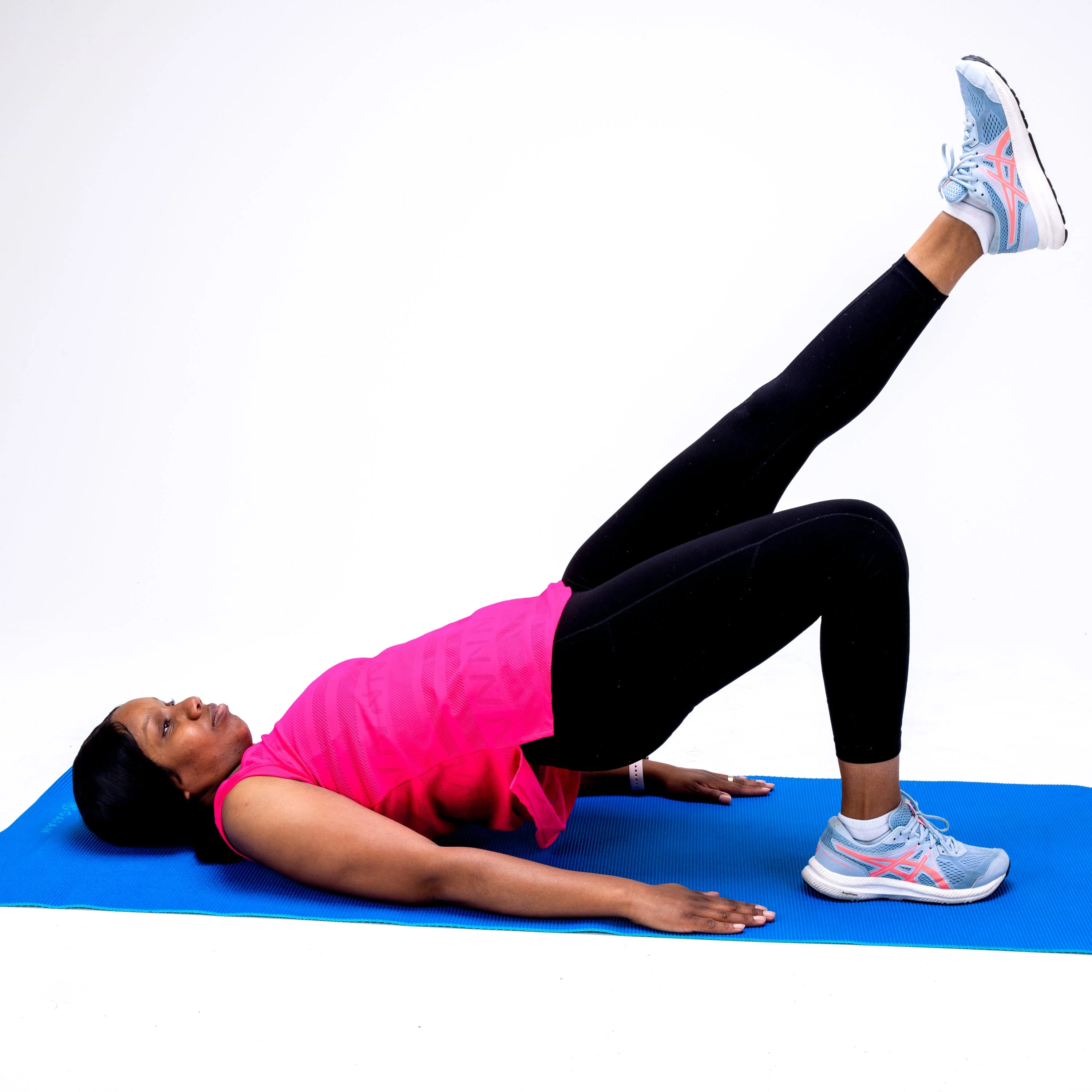
- Lie faceup with arms straight by sides. Bring feet hip-width apart, approximately six inches away from fingertips.
- Place fingertips on hip bones to maintain alignment and lift hips off the ground, engaging glutes.
- Keeping hips high and level, straighten out one leg.
- Hold this position for as long as you can, up to 30 seconds.
- Note how many seconds until hips drop or hamstring cramps.
Single-Leg Glute Bridge Variations
Milton uses two versions of the single-leg glute bridge with her clients, depending on their training goal. She typically suggests doing these moves two to three days per week, on nonconsecutive days.
💪To Enhance Hip Stability and Endurance
- Hold the position described above for longer, up to 90 seconds per side.
- Do at least 3 sets per side.
🏋️♀️To Build More Strength
- Use the same setup as described above, but place a dumbbell across the working hip.
- Lift and lower hips, driving grounded foot into the floor, and holding for 1-3 seconds at the top.
- Repeat for 8-12 reps before switching sides.
- Do 3 sets.
Keep in mind that if this exercise feels difficult, it doesn’t mean you’re headed for injury. But depending on how challenging it is, it can indicate weaker muscle groups. The key is to start slowly and gradually increase the duration of your single-leg glute bridge hold and how frequently you perform the exercise. Building this strength takes time and consistency, but it may become a promising injury buffer.

Morgan is a gear editor who has been with Runner’s World since 2017. She started as an intern ghostwriting The Warmup, a bygone version of the daily RW newsletter. Now, she tests and reviews anything you might find on runners’ feet-from crew socks and compression boots to carbon-plated super shoes.
A lifelong runner and shoe geek, Morgan has been chasing the perfect pair of kicks since she joined her grade school cross-country team. Since then, she ran as a Division I walk-on for the cross-country and track & field teams at the University of Delaware, where she studied English and Biology. She has one full marathon under her belt, and has raced more halfs and 5Ks than she can count.
