It was an ill-fated race that jump-started Larry Rutledge’s epic marathon journey.
Not having run since high school, where he did track and cross country, Larry was encouraged by his wife’s boss, Bill, to take part in the BancOhio Bucket Brigade in their hometown of Dellroy, Ohio, a 5-mile race sponsored by the bank where she worked. The race did not last beyond that first year—an elderly man reportedly drove onto the course and injured a runner (thankfully, not critically)—but it revived Larry’s love for running.
“After that race, I realized how much I missed the runner’s high,” says Larry, who is now 71. Training for that 5-miler had also given him something else he’d missed: a routine. “I started to look forward to coming home every night, lacing up my running shoes and taking off again.”
Larry started wondering whether he could complete 26.2 miles. “I thought, if I could run a marathon and complete the whole thing, I would just be so happy,” he says, a case filled with trophies and certificates in the background of his video. That goal led him to the starting line of the 1988 Pittsburgh Marathon, where he and Bill completed their first marathon together in under four hours.
Buoyed by their time, Larry and Bill did a handful of races together, training minimally and focusing on their medals rather than finish time. While Bill felt like he had hit his limit in these races, he believed Larry had the speed to take on Boston. The thought excited Larry. He began training seriously, buying Hal Higdon’s Marathon book and figuring out what to do—and more importantly, what not to do. Early on, he learned a valuable lesson. “I wasn’t pacing properly; I was running about a seven-minute-mile pace at the beginning, but then I dropped off to like nine and a half minutes at the finish,” he says.
His breakthrough came at the 1993 Cleveland Marathon. “I got it all together,” Larry says. “I ran a 3:12 and change—I had to break 3:15 to qualify for Boston.” A year later, at 39, Larry lined up at the Boston Marathon for the first time, finishing in 3:22:08. He’s run every Boston since then, becoming a member of the Boston Marathon Quarter Century Club in 2018 after running 25 consecutive Bostons, which grants him automatic entry into the race for life. This year marked his 33rd finish in 5:43:26.
It was only when he hit the 25th Boston Marathon milestone that Larry began thinking about his total marathon count. Boston was just one of several marathons he’d run in a single year. “I started counting them up, and I thought, ‘Wow, that’s really adding up to quite a number.’” He was able to recall many of them thanks to medals and finisher shirts he had saved. “We had one box that we’d throw them in,” he says. The count has come to about 260 marathons.
“People would say when they came to visit, ‘There’s nothing displayed,’” adds his wife, Anita. “We built a new home in 2017, and that was the first time we started displaying any of them.”
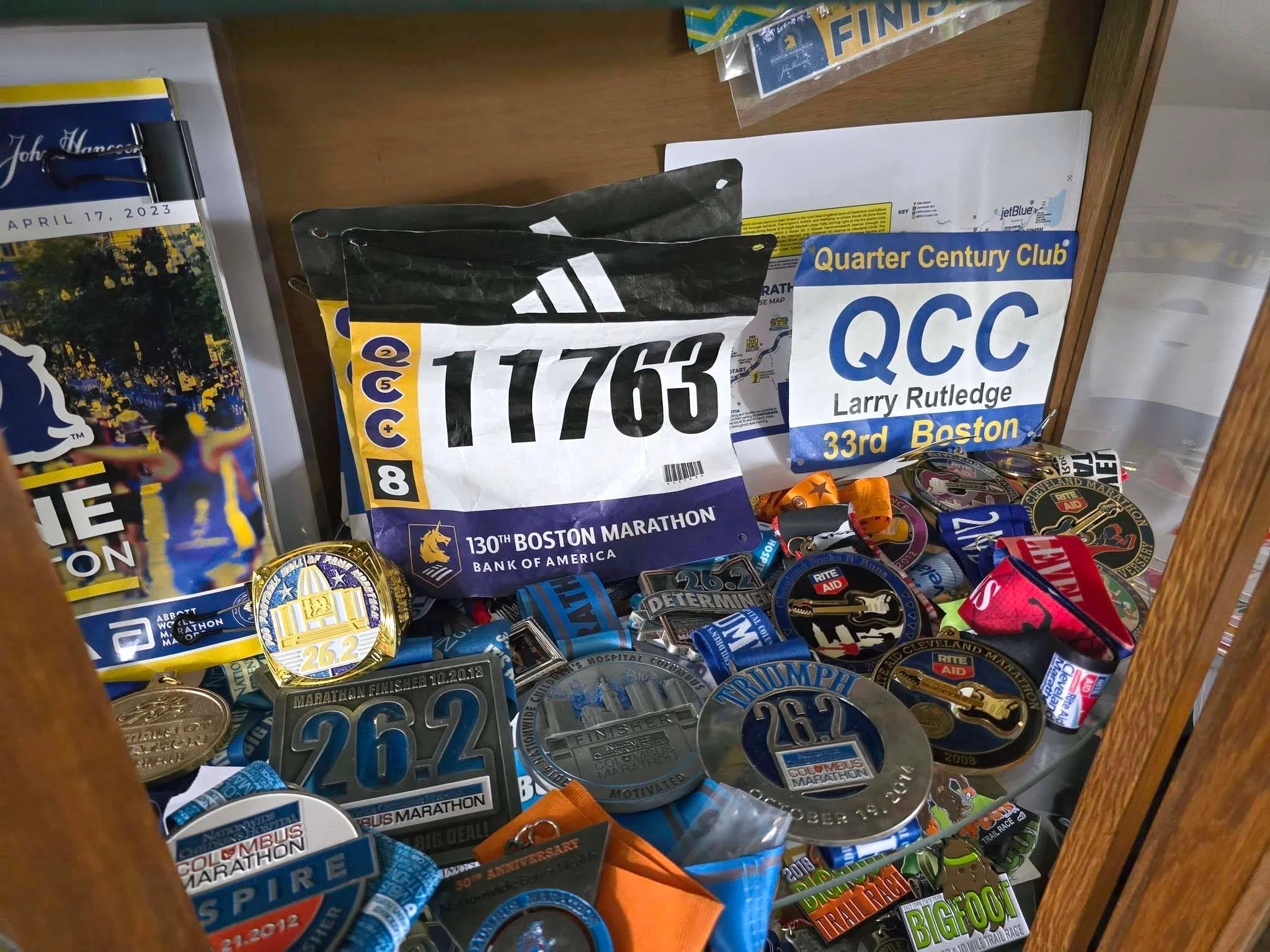
There were stretches where Larry ran around eight marathons a year, he says. He’s also completed several ultramarathons—50Ks, 50-milers, and, in 2004, the Dan Rossi 100-miler, which he finished in 25 hours and 13 minutes. If we don’t count Massachusetts or occasional marathons in places like Kentucky, Pennsylvania, or South Carolina, much of his total comes from races close to home. “That is my fault,” says Anita, his staunchest supporter. “I told him, ‘If we can drive to it, I’ll go with you.’”
In all the marathons he’s done, Larry says he’s never DNF’d, though he was close during one Pittsburgh Marathon. “I remember I was at the 20 or 22 mile mark, and I thought, ‘Wow, this is really hot, I’m really struggling, but I’ve got to get to the finish to get back to the car to go home, so I’m just going to hang in there, and I’m going to face this race and get my medal.’” The only time he’s been sidelined was when he had to have his colon removed for a perforated bowel, which caused severe pain and forced him to cut a 10-mile run to six; the surgery took him about a week to recover from.
He takes a two-month break from running after Boston, and he credits this time off—and proper warmup—with staying injury-free. His wife, who is not a runner herself, is another big reason for his longevity in the sport. “[Running] kind of cuts into family time, and she says, ‘I know you’ve got to do what you’ve got to do,’” Larry says.
Anita believes Larry’s success comes down to his drive. “He has this built-in determination in his soul that this is something that he wanted to do, and he has devoted himself to it so strongly,” she says. “He would set out to do something, and then he would do it. He trained himself. He has no coaches, no dieticians, no one; he learned to do this himself. This was a guy who picked up a book and said, ‘I'm going to figure this out.’”
For Larry, that drive comes from within. “What always made the difference was I was a self-motivator,” he says, describing how he used to come home late from his shift as a line operator. “I’d be sitting on the couch, and I’m really tired. I think, ‘I’m going to go to bed.’ And then, I’d say ‘You know, between now and the marathon, you’ve only got so many days. You throw one away and never get it back. All right, I’m going to get my shoes, I’m going to go and get at least five, six miles in.’” He’d hit the local bike path along Atwood Lake or use his basement treadmill if it were too cold or dark outside.
In recent years, Larry has reduced the number of races he runs to two or three marathons a year. He and Anita live on a farm, and so, in addition to his job, he doesn’t have as much time to devote to training. He can also feel he’s slowing down. “I still try to run as much and to train as much as I can because I just enjoy running,” he says.
Five Lessons From Larry Rutledge’s 260-Plus Marathon Career

➡️ Pace Yourself
When Larry first began racing seriously, he noticed that he’d start out at around a seven-minute-mile pace and drop to around 9:30. “It showed me I needed to conserve my energy in the first part of a marathon, so that I’d have more in the second half.” By his first Boston Marathon, he nailed negative splits.
➡️ Progress Steadily
Once Larry has a base, he adds small increments to his long runs and sticks to the distance until he feels comfortable with it. “There were times when I thought, ‘I’d done two or three miles—I could bump it up to five or six,’ but I would feel really slow on the way back home, and realize I overshot this one,” he says. Increasing mileage slowly is key in his training.
➡️ Take the Time to Taper
In his early marathon years, Larry would push too hard, running high mileage right up until the marathon and then feel disappointed with his finish time. “Then I started to figure out that most marathons have at least a two-week taper, and some of them three,” he says. “I had a much better result from following that.”
➡️ Don’t Neglect Pre- and Postrun Stretching
Larry has a five-exercise warmup routine and does postrun stretching to cool down. While training for the Columbus Marathon one year, he felt a pain in his groin—then he remembered he hadn’t stretched; he’d never make that mistake again. “Even when I’m doing short runs and only have time to do four or five miles, I always go through my stretching routine, every single time.”
➡️ Train Your Mind
During the 100-miler, Larry hit a mental block at mile 75 and wasn’t sure whether he’d be able to finish. “I said to myself, ‘You gotta keep on going because if you quit now, you got nothing.’” What worked for him? He would think back to the nights he’d come home from work around midnight, feeling exhausted but still go for a run, reminding himself that he can do hard things, leaning into his strength and determination.
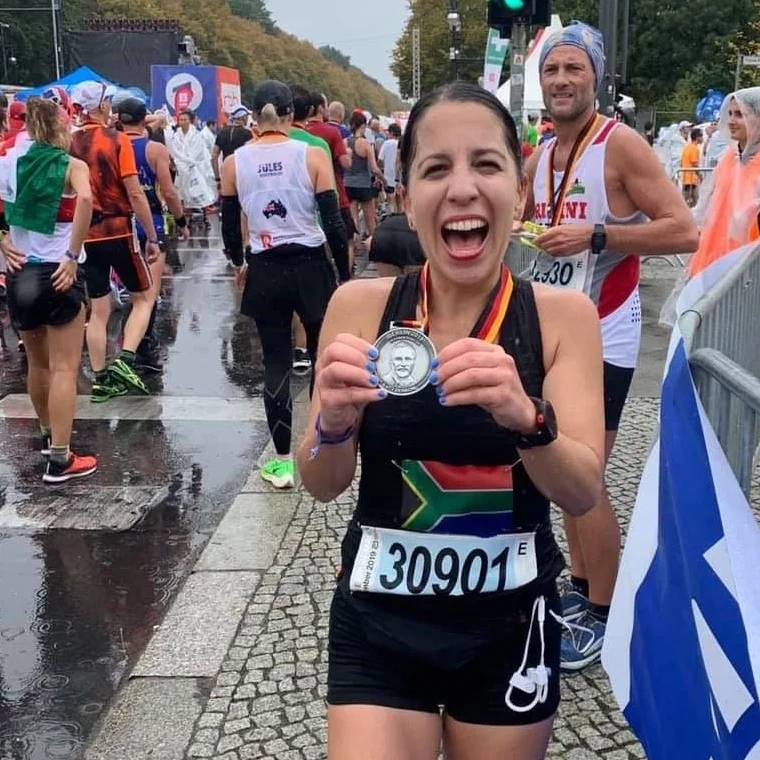
Nadia Neophytou is a freelance journalist from South Africa, based in New York City, who writes for a variety of publications, from The Hollywood Reporter to Deadline, Quartz, CNN, and more. When she’s not interviewing movie stars and musicians, she’s running—or talking about running in a video series she created called The Rundown, where she interviews people she admires on the run.
