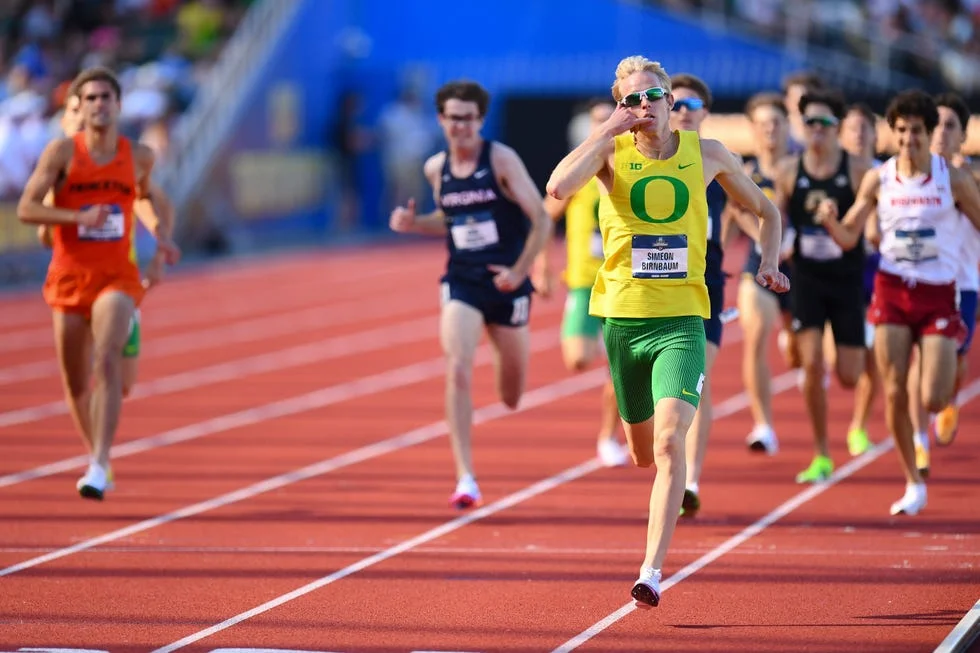
When University of Oregon junior Simeon Birnbaum set the collegiate record in the 1500 meters in April, he was wearing a green Nike singlet, with the image of the Oregon Duck emblazoned on the front, and Nike spikes. He sped to a time of 3:31.69 on his home track at Hayward Field in Eugene, Oregon, lowering the previous mark, held by Liam Murphy of Villanova, by nearly a second and a half.
Birnbaum, 21, went on to win the NCAA title in June, gapping the field, and on July 18, he’ll line up for the mile at the London Diamond League meet. That meet is set to be a world-record attempt by Josh Kerr of Great Britain. Olympic bronze medalist Yared Nuguse is in the field as well.
Birnbaum, however, won’t be wearing his Oregon uniform and he won’t be wearing Nike spikes, either. He’ll be wearing the spikes of one of Nike’s smaller rivals, Diadora, an Italian brand that signed Birnbaum to an NIL deal in January.
In Birnbaum’s telling, the deal caused some heartburn around the Oregon campus while he was negotiating it.
“Not going to lie, it was pretty awkward,” Birnbaum, who is a business major and does not have an agent, said at a media lunch Diadora executives organized in Eugene, Oregon, on July 2. “There were a lot of intense conversations and stuff.”
Birnbaum said he didn’t go into negotiations with Nike assuming he would sign with the hometown brand.
“I wasn’t going to go to them easily, like, I was going to make them work for it, and eventually they were just like, ‘We’re done.’ I was like, ‘Okay. That's what I want to hear. Just tell me that.’”
In response to questions from Runner’s World, a Nike spokesperson said, “We don’t comment on sports marketing contracts.”
Jerry Schumacher, Oregon’s head cross-country and track-and-field coach as well as coach to several professional Nike athletes, downplayed any awkwardness.
“Oregon is, obviously, we would consider it an important big Nike school, as there are others, I’m sure, that are super important to Nike as well,” he said. “But it’ll be impossible for any one brand to sign every athlete at every university just based on what their affiliation is with the university. So, I don’t get in the way of that. However that plays out, it plays out. I’m happy for our student-athletes when they get some sort of NIL deal that works for them. If they’re excited about it, then I’m excited for them.”
The terms of the NIL deals, including Birnbaum’s, are private. Agents estimated for Runner’s World that for top runners, those deals could be worth roughly $75,000. NILs are often most valuable for giving the brands a head start on developing a relationship with runners for when they go pro. And most NIL contracts are written in a way that gives the NIL sponsor the right to match other pro offers when the time comes. In the case of Birnbaum, one of the country’s most promising young distance runners, Diadora will have the first rights to his services when he’s a pro.
The secrecy around these deals just adds to the mystery of Birnbaum’s situation: How did the colossus Nike—whose swoosh is all over Hayward Field—lose its star runner to an NIL deal with Diadora?
A pair of free thinkers
At the lunch, Diadora executives brought together Birnbaum and Marco Langon, also 21, of Villanova, another middle-distance runner from a Nike-backed athletic department who signed an NIL with Diadora. Langon, who has the No. 2 time in the 1500 meters in collegiate history, 3:32.79, announced that day he would be continuing with Diadora for his professional career.
Langon reached out to Diadora initially and signed an NIL deal with the brand in the summer of 2025.
Ryan Eckel, who is Diadora’s chief marketing officer in the U.S., responded to Langon’s outreach. He said it made sense for the brand to go after college athletes. Eckel spent five years as the brand president at Tracksmith, and he said that many companies are focused on older athletes running marathons.
“We wanted to go younger,” he said. Their filter, he said, is athletes the company believes can medal in 2032.
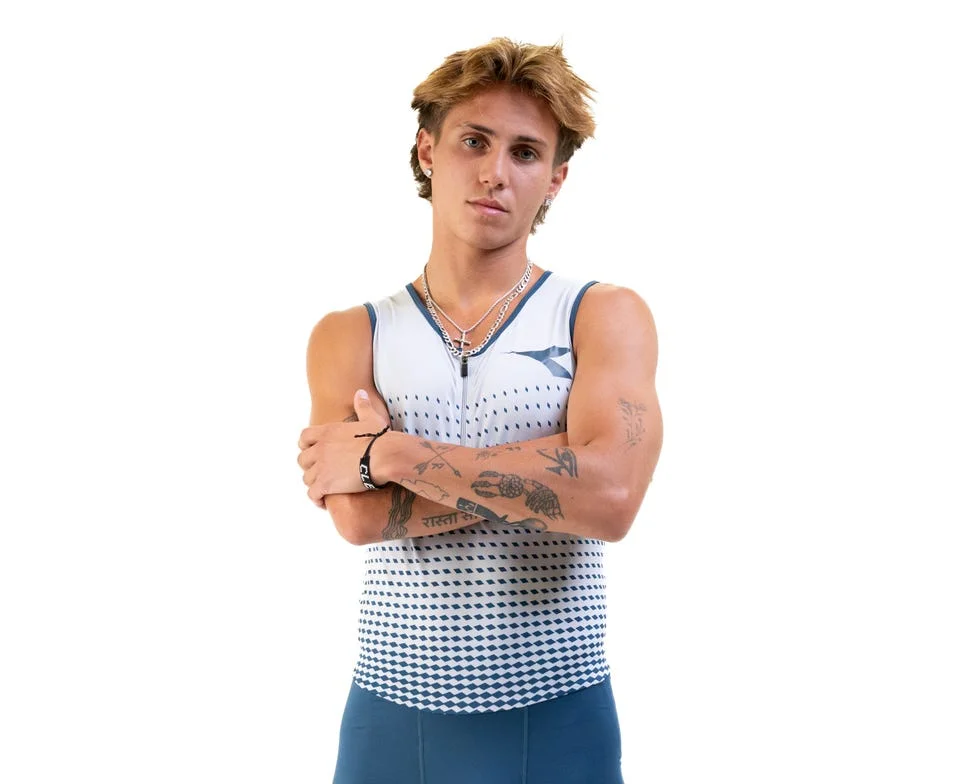
Langon went to Philadelphia to meet with Eckel and others from Diadora. To break the ice, Eckel asked Langon about his workout that morning. Langon launched into what Eckel called a “20-minute soliloquy” about the workout, every millimole of lactic acid that he tested and the history of Villanova running and Jumbo Elliott, the university’s legendary coach for 32 years.
“I was like, ‘Oh my god, this kid is super interesting,’” Eckel recalls. “He knew everything about his training. He was obsessed with it.”
After Langon’s NIL deal became public, Birnbaum—a rival at the top of the NCAA middle-distance ranks—reached out to Langon for advice. Soon Birnbaum, too, was on his way for his own meeting with Diadora brass, this one in Flagstaff, Arizona.
“I'll say this, he is a super intelligent kid, highly intelligent,” Eckel said of Birnbaum. Eckel has deployed Birnbaum to represent the brand in various ways, including talking to Diadora sales teams, because he can’t be seen wearing Diadora products on the Oregon campus or during collegiate races. “He's got a wisdom that I think is really, really unusual for somebody who's that age.”
By Birnbaum’s own account, however, one recent decision was not too wise: He made an Instagram post for Bicarb, a sports fuel company that he also has an NIL deal with, and the post featured guns. It drew a swift backlash.
“Honestly, I didn't think too much about that,” Birnbaum said. “We needed to do an announcement, and one of my buddies also works with [Bicarb], and he was like, ‘Oh, we could just incorporate these guns.’”
Birnbaum grew up hunting in South Dakota and said he “didn’t think twice about it.” He quickly realized it was “not the smartest thing.” The post remains on his account.
As a high school athlete, Birnbaum was highly decorated. He ran the second-fastest prep times in history in the 1500 meters (3:37.93) and two miles (8:34.10).
When he got to college, though, he struggled with stress injuries under more intense training. But by his sophomore year, he was healthy and improving—he was fourth at the Big Ten cross-country championships and ran 3:52.81 for the mile indoors. He made the 1500-meter final outdoors and finished seventh.
Junior year, it continued: He was 33rd at the NCAA cross-country meet before he inked the NIL deal. After the deal, he was second indoors at 3,000 meters before setting the 1500-meter record and later winning the outdoor title. Schumacher believes Birnbaum still has plenty of room for improvement in events like the 800, 1500, and 5,000 meters.
Birnbaum said he ran about 70 miles per week this year, a big jump from high school. He hopes to get into the 80s in the fall. “I’d love to run more,” he said, in a follow-up call with Runner’s World from Italy, where he was training and visiting Diadora headquarters. “It’s just I’ve got to be patient with my body to develop.”
He also leaves some uncertainty about his future at Oregon. Asked about whether he’d use all his collegiate eligibility, he said: “I don’t know. No idea.”
Birnbaum said some of the classes he’s taken toward his Oregon business degree have been helpful in thinking about his career.
“There’s a lot of stuff about people management, so it’s a little bit of psychology,” he said, as well as the case studies about how businesses run—and what goes wrong. He listened to Schumacher and others as he weighed his NIL options but ultimately kept his own counsel. His parents took a step back. “They just trust me,” he said. “They’re like, ‘You’re going to know better than we would.’”
A “Moneyball” brand
For Eckel and the team at Diadora, enthusiasm abounds about their two young stars. Eckel said they want to add women to their list of sponsored athletes. And they want to remain flexible about what’s going to help the runners achieve their best, an athlete-first vision that comes from Diadora’s president, Enrico Moretti Polegato.
Langon doesn’t want a branded training group; he plans to live in Boston and for hard workouts team up with some of the other pros who call that city home. Birnbaum said he trains better with people around him, but he struggles on Oregon’s annual September trip to altitude in Park City. The formal team model that brands like Nike, New Balance, and Brooks have adopted—with mixed results—might not suit him, either.
“They’re both super independently minded,” Eckel said of the two runners. “They question kind of what's expected of them, the traditional path.” It fits with the company, whose guiding principle is: We just want to help you get to the Olympics and win a medal. The company has every intention, he said, of having relationships with both athletes long into the future.
Diadora has Langon for at least the next few years—track contracts are typically three to five years, depending on when they begin in the Olympic cycle—but it wouldn’t be surprising to see Nike take another run at signing Birnbaum whenever he decides he’s ready to leave college. Schumacher said he always hopes to keep working with athletes as pros once they leave Oregon. “It's really fun to start working with someone when they're 18 years old and get to continue working with them,” he said. “Especially since I kind of know the pro world pretty well, so I think I have a lot to offer.”
With Langon and Birnbaum, who almost fell into their laps, Eckel feels like he’s gotten a little bit lucky. Their budget is a fraction of that of other footwear giants. “I feel like I'm playing ‘Moneyball,’” he said, “where we have to find ways to make an impact on the sport and on the category and on consumers and also on the athletes and trying to find these opportunities to do it.”
Every brand is different, Eckel points out, with different business challenges that it’s trying to solve for. Diadora is just trying to get on the map with young runners. Birnbaum and Langon “helped more than any ad campaign I could spend money on,” Eckel said. “I think it's the best money we've spent, no question.
“We've got a guy running the Diamond League in London, wearing our kit,” he continued. “Which is incredible.”

Sarah Lorge Butler is a writer and editor living in Eugene, Oregon, and her stories about the sport, its trends, and fascinating individuals have appeared in Runner’s World since 2005. She is the author of two popular fitness books, Run Your Butt Off! and Walk Your Butt Off!
